
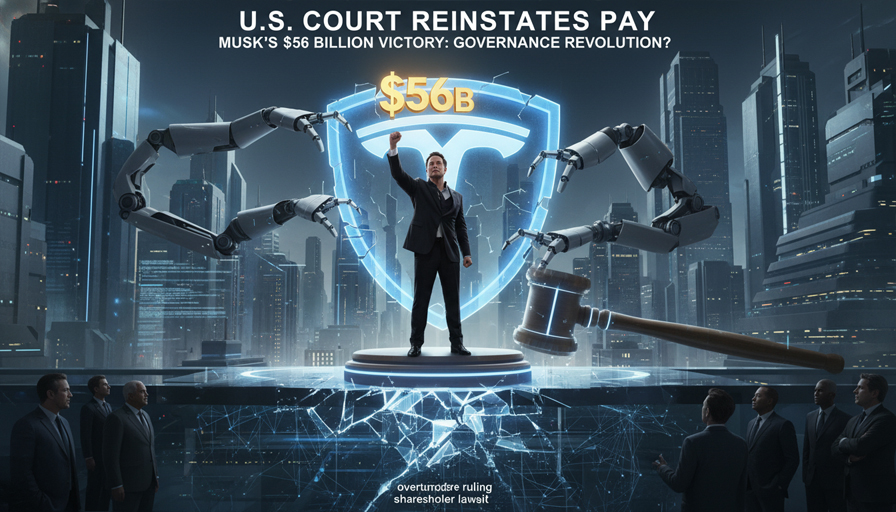
Elon Musk’s $56 billion Tesla compensation package has been reinstated after a U.S. court overturned a prior ruling, reshaping executive pay debates and corporate governance standards.
Elon Musk has secured a major legal victory after a U.S. court reinstated his controversial Tesla compensation package, valued at approximately $56 billion. The ruling reverses an earlier decision that invalidated the deal and restores what is widely considered the largest executive pay package in modern corporate history. As a result, the outcome sends powerful signals across the technology, automotive, and financial sectors.
The compensation plan, first approved in 2018, was structured around a series of aggressive performance milestones. These benchmarks required Tesla to achieve extraordinary market capitalization growth, revenue expansion, and operational targets. Over the years, Tesla exceeded many of these goals, evolving from an electric vehicle disruptor into a dominant global force in both transportation and energy innovation.
Why Elon Musk’s Tesla Compensation Package Was Challenged
Despite Tesla’s success, the pay package faced intense legal scrutiny. Earlier in the year, a Delaware Chancery Court judge ruled that the approval process was flawed. The court argued that Tesla’s board lacked sufficient independence and that shareholders were not fully informed when voting on the plan. At the time, the judge described the compensation as excessive and ordered it rescinded.
This ruling triggered widespread debate around executive compensation, shareholder rights, and governance standards — especially for founder-led technology companies. Coverage of similar governance disputes frequently appears within the Tech Policy & Law category, where regulation and corporate accountability intersect.
U.S. Court Reinstates the Tesla Pay Deal
Following the decision, Musk’s legal team appealed, emphasizing that Tesla shareholders benefited massively from the company’s explosive growth. The appellate court ultimately sided with Musk, overturning the prior judgment and reinstating the compensation package. Although detailed legal reasoning is still being analyzed, the ruling affirms that performance-based incentives tied to shareholder value can withstand judicial scrutiny.
This outcome reinforces arguments long supported by market analysts and financial regulators, including guidance outlined by the U.S. Securities and Exchange Commission regarding executive disclosures and shareholder voting frameworks.
What This Means for Executive Pay and Corporate Governance
The reinstatement of Elon Musk’s Tesla compensation package sets a powerful precedent. Boards may now feel emboldened to design bold, performance-driven pay structures for visionary leaders. At the same time, shareholders and regulators are likely to demand even greater transparency and governance safeguards.
This ruling is especially relevant within the broader technology ecosystem, where founder-CEOs often retain outsized influence. Similar governance dynamics continue to shape companies across artificial intelligence, automotive innovation, and future technology — topics closely followed in the Enterprise Tech and Future Tech categories.
Tesla’s Growth and the Road Ahead
Tesla’s rapid expansion played a central role in the court’s decision. Under Musk’s leadership, the company’s valuation surged, production scaled globally, and its influence extended into energy storage and AI-driven automation. These achievements strengthened the argument that the compensation package rewarded tangible, measurable results rather than speculative promises.
However, the ruling also reignites questions about balance. How should companies reward transformational leadership while maintaining accountability? As executive compensation continues to rise across the tech sector, governance frameworks will face increasing pressure to evolve.
Final Thoughts
The reinstatement of Elon Musk’s Tesla compensation package is more than a legal win for one executive. It marks a defining moment in the ongoing debate over performance-based pay, shareholder power, and corporate governance. As technology companies continue to reshape global markets, this decision is likely to influence boardroom strategies and compensation models for years to come.
Source: TechNewsWorld