
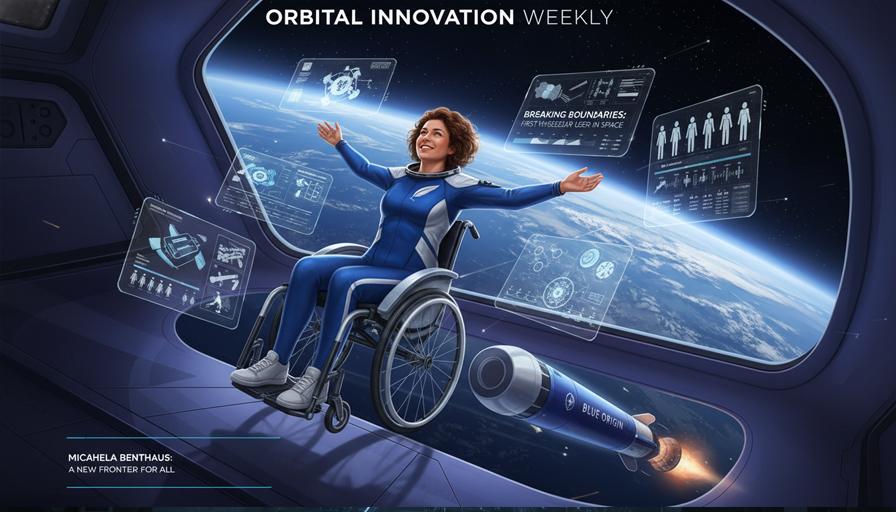
Blue Origin has successfully launched Michaela Benthaus, the first wheelchair user, into space. This historic mission marks a major breakthrough for accessibility in space travel and highlights the growing role of private companies in building an inclusive space future.
Blue Origin has achieved a historic milestone in modern spaceflight. The company successfully launched Michaela Benthaus, the first wheelchair user to travel into space. This breakthrough mission signals a powerful shift in how accessibility is viewed within the aerospace industry.
Flying aboard Blue Origin’s New Shepard rocket, Benthaus crossed the Kármán line, the internationally recognized boundary of space. During the suborbital mission, she experienced weightlessness and viewed Earth from above. As a result, this flight proved that physical disability is no longer an automatic barrier to space travel.
Blue Origin’s Accessibility Milestone in Space Travel
Although Blue Origin has not disclosed every technical modification made for the flight, the mission’s success speaks clearly. The spacecraft operated smoothly from launch to landing. More importantly, it demonstrated that inclusive spacecraft design is achievable with intentional engineering.
This achievement strengthens Blue Origin’s position within the Space Tech ecosystem. It also reinforces the idea that accessibility should be integrated into future spacecraft from the earliest design stages.
Why the First Wheelchair User in Space Matters
Michaela Benthaus is not only a passenger. She is a highly skilled engineer whose journey represents resilience and progress. For decades, space programs favored narrow physical requirements. Consequently, many talented individuals were excluded.
However, this mission changes that narrative. It sends a global message that space exploration can be inclusive. In turn, it inspires people with disabilities to pursue careers in science, engineering, and space research.
Private Space Companies Driving Inclusive Innovation
Private aerospace companies are now shaping the future of spaceflight. Unlike traditional government missions, commercial programs can move faster and experiment more boldly. Blue Origin’s decision reflects this flexibility.
As part of the broader Future Tech movement, the company is expanding access to space tourism and research missions. This approach also complements ongoing developments in Robotics & Automation, where adaptive systems play a growing role.
The Broader Impact on Accessible Space Exploration
The impact of this mission extends well beyond one flight. It challenges aerospace organizations to rethink crew training, spacecraft interiors, and ground operations. As a result, future missions could support astronauts with a wider range of physical abilities.
Experts believe this milestone may accelerate inclusive design across the industry. According to NASA, accessibility-focused innovation often leads to safer and more efficient systems overall. Similarly, ESA has emphasized universal design as a driver of long-term mission success.
What Comes Next for Blue Origin and Space Accessibility
Looking ahead, Blue Origin’s achievement may influence orbital missions and long-duration space travel. As commercial spaceflight evolves, accessibility will likely become a competitive advantage rather than an exception.
Ultimately, the mission proves one powerful truth. Space is no longer reserved for a select few. With the right technology and mindset, the cosmos can belong to everyone.
Source: ScienceDaily