
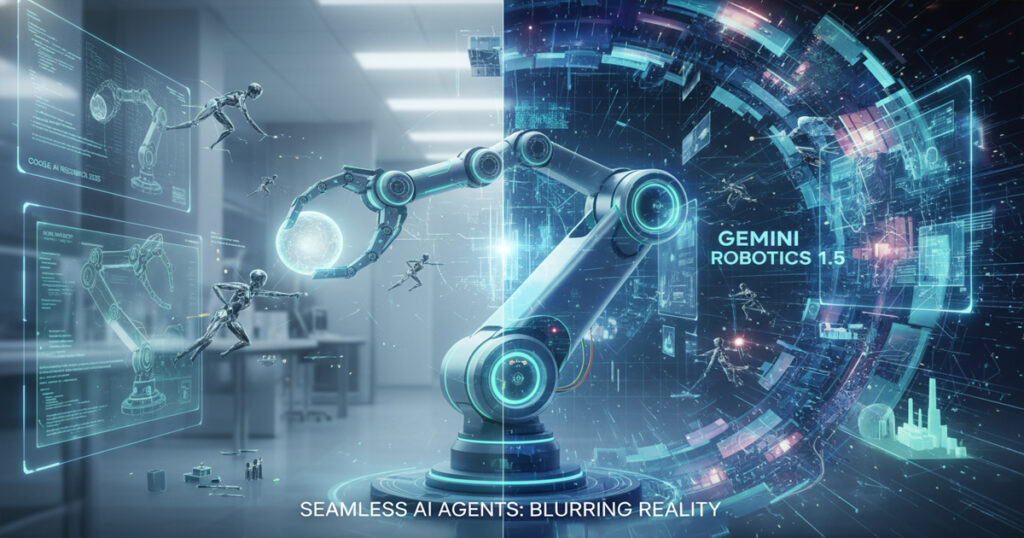
Google’s 2025 review highlights major progress with Gemini Robotics 1.5, integrating AI agents across physical and virtual environments to enable greater autonomy, adaptability, and advanced automation.
Google is setting the pace for the next phase of artificial intelligence. In its latest 2025 AI research review, the company spotlighted Gemini Robotics 1.5 as a major leap toward embedding intelligent AI agents into both physical environments and virtual systems.
This evolution reflects Google’s broader ambition to move beyond static automation. Instead, the company is building AI systems that can perceive, reason, and act with minimal human intervention. As a result, robotics is entering a new era defined by adaptability and real-world intelligence.
What Makes Gemini Robotics 1.5 Different
Traditional robots rely on rigid programming and predictable conditions. However, real-world environments are rarely stable. Gemini Robotics 1.5 addresses this gap by combining multimodal AI, advanced perception, and contextual reasoning.
With this approach, robots can interpret visual, spatial, and language-based inputs at the same time. More importantly, they can adjust behavior dynamically when conditions change. This marks a shift from scripted automation to learning-driven autonomy.
AI Agents Operating Across Physical and Virtual Worlds
One of the most important aspects of Gemini Robotics 1.5 is its dual-domain capability. AI agents can now operate inside virtual simulations while also performing tasks in physical spaces.
In virtual environments, these agents can train safely and rapidly. They learn through simulation, refine skills, and test scenarios without physical risk. Once trained, they can transfer that knowledge directly to real-world robots.
This approach significantly shortens development cycles. It also improves reliability when robots are deployed in factories, warehouses, and public spaces.
Real-World Impact on Automation and Industry
The implications for automation are substantial. Industrial robots could reconfigure workflows on demand. Service robots may respond naturally to human gestures and voice cues. In logistics, AI-powered systems could adapt instantly to disruptions.
Beyond robotics, these advances influence the broader Robotics & Automation ecosystem. They also accelerate progress across Artificial Intelligence research and deployment.
Google’s work aligns with wider industry trends toward intelligent agents capable of reasoning, collaboration, and self-improvement.
Challenges Around Safety and Ethics
As autonomy increases, so does responsibility. Google acknowledges that safety, transparency, and ethical design remain critical. AI agents must operate within clearly defined boundaries and maintain predictable behavior.
Researchers continue to focus on alignment, fail-safe mechanisms, and human oversight. These safeguards will be essential as robots gain greater independence in real-world settings.
Why Gemini Robotics 1.5 Matters Long-Term
Gemini Robotics 1.5 represents more than a technical upgrade. It signals a long-term strategy to merge physical and digital intelligence into a unified system.
If successful, this convergence could redefine how humans interact with machines. From manufacturing to healthcare and education, adaptive AI agents may soon become trusted collaborators rather than simple tools.
As competition intensifies across Future Tech, Google’s progress positions it at the forefront of next-generation automation.
Sources: Google AI Blog, Fudzilla