
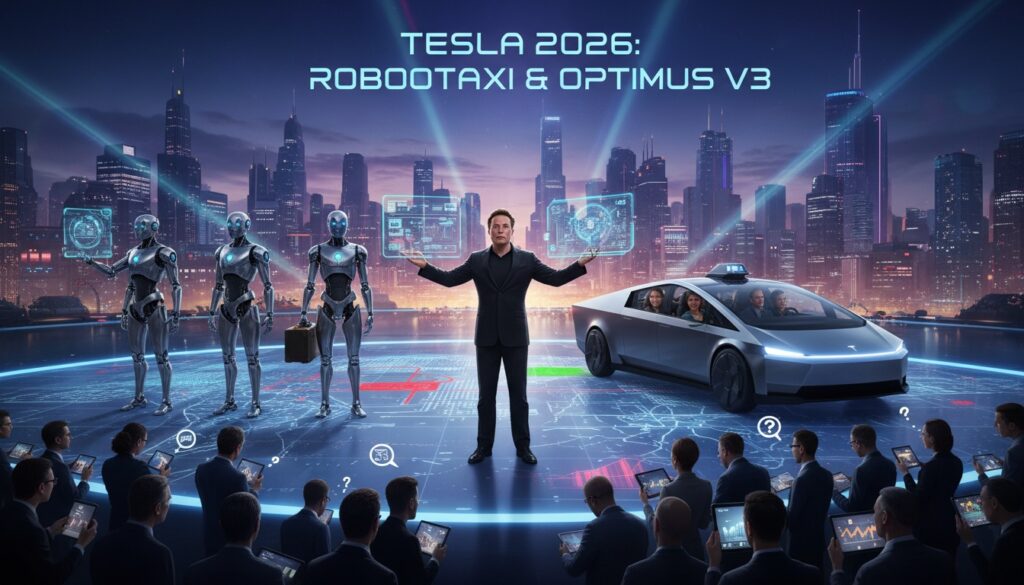
Elon Musk announced Tesla’s bold 2026 vision: widespread robotaxi services and the Optimus V3 humanoid robot launch. This accelerates Tesla’s dive into autonomous mobility and advanced robotics, potentially reshaping transportation and labor markets.
Elon Musk has once again placed Tesla at the center of global tech conversations. In a recent announcement, the CEO outlined an ambitious roadmap targeting 2026 as a breakthrough year for two major initiatives: the large-scale rollout of the Tesla robotaxi network and the commercial launch of the Optimus V3 humanoid robot.
This announcement reinforces Tesla’s evolution beyond electric vehicles. The company is positioning itself as a leader in autonomous mobility and advanced robotics, two sectors expected to redefine transportation, labor, and industrial automation over the next decade.
Tesla Robotaxi Ambitions for 2026
The concept of a Tesla robotaxi fleet has long been central to Musk’s vision for autonomous driving. The idea centers on fully self-driving vehicles operating as on-demand ride-hailing services without human drivers.
While Tesla’s Full Self-Driving software has made steady progress, achieving widespread robotaxi deployment by 2026 would require genuine Level 5 autonomy. This means vehicles capable of operating safely in all driving environments without human intervention.
Beyond technical hurdles, regulatory approval remains a significant barrier. Autonomous transportation laws vary widely across regions, making global deployment of a Tesla robotaxi network a complex and highly scrutinized challenge.
Optimus V3 and Tesla’s Push Into Humanoid Robotics
Running parallel to the robotaxi vision is the planned launch of Optimus V3, Tesla’s latest humanoid robot. Since its first unveiling, Optimus has demonstrated basic task execution, signaling early progress in physical AI.
A V3 release implies substantial improvements in dexterity, autonomy, and real-world usability. If successful, Optimus V3 could help address labor shortages, automate dangerous jobs, and support industries such as manufacturing, logistics, and warehousing.
This move further strengthens Tesla’s footprint within the Robotics & Automation ecosystem, where humanoid robots are increasingly viewed as the next frontier.
Can Tesla Meet Its 2026 Timeline?
Despite the excitement, skepticism remains. Tesla has a history of optimistic timelines, particularly around autonomous driving milestones. Delivering a fully operational robotaxi network and a commercially viable humanoid robot within the same timeframe is an enormous undertaking.
Engineering challenges, software reliability, mass production logistics, and regulatory compliance all present substantial risks. Even so, incremental success in either area could have far-reaching consequences for Tesla’s long-term valuation and influence.
Why Tesla’s 2026 Vision Matters
If Tesla succeeds, the impact would extend well beyond the company itself. A functioning Tesla robotaxi ecosystem could disrupt traditional vehicle ownership models and reshape urban mobility. Optimus V3 could redefine automation by bringing general-purpose robots into everyday industrial use.
These developments intersect closely with advancements in artificial intelligence, explored further in our Artificial Intelligence coverage.
Broader industry context on autonomous vehicles and robotics innovation can also be found via authoritative reporting from Reuters Technology.