

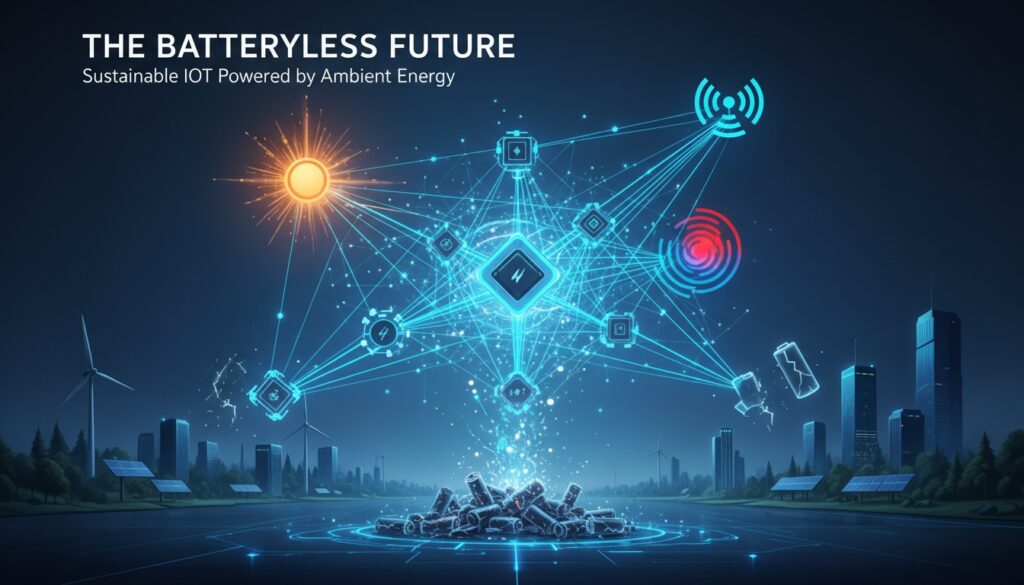
Batteryless and ultra-low power IoT devices, powered by energy harvesting from sources like solar and RF, are revolutionizing sustainable technology. This innovation drastically cuts e-waste and maintenance, enabling massive, eco-friendly IoT deployments for a greener digital future.
The Internet of Things continues to expand at a remarkable pace. Smart homes, industrial sensors, environmental monitors, and agricultural networks now rely on billions of connected devices. However, this growth has exposed a critical limitation: power.
Traditional IoT deployments depend heavily on batteries. At scale, this creates serious environmental and operational challenges. Battery manufacturing, replacement, and disposal contribute significantly to electronic waste while driving up maintenance costs—especially for devices deployed in remote or inaccessible locations.
Why Batteryless IoT Is Becoming a Necessity
To achieve a truly scalable and sustainable IoT ecosystem, the industry must move beyond batteries. This is where batteryless IoT devices and ultra-low power architectures enter the picture.
Recent advances in energy harvesting technologies are making it possible for IoT devices to operate indefinitely by drawing power from their surrounding environment. This shift fundamentally changes how connected systems are designed and deployed.
How Energy Harvesting Powers Ultra-Low Power IoT Devices
Energy harvesting works by capturing small amounts of ambient energy and converting it into usable electrical power. Several techniques are now proving viable at scale.
Miniature solar cells can power sensors in well-lit environments. RF energy harvesting extracts power from ambient Wi-Fi, cellular signals, or dedicated transmitters. Thermal harvesting converts temperature differences into electricity, making it ideal for industrial settings. Kinetic harvesting taps into vibration or movement.
By combining these methods with ultra-efficient microcontrollers and sensors, manufacturers can build batteryless IoT devices that operate reliably without traditional power sources.
Environmental and Operational Benefits of Batteryless IoT
The environmental impact is immediate and significant. Reducing battery usage directly addresses the growing e-waste problem and lowers the carbon footprint associated with battery production and logistics.
From an operational standpoint, maintenance costs drop dramatically. Devices no longer require periodic battery replacement, making them ideal for long-term deployment in smart infrastructure, precision agriculture, industrial monitoring, and environmental sensing.
These advantages are accelerating adoption across sectors closely aligned with Internet of Things (IoT) and GreenTech & Sustainability.
Challenges Still Facing Batteryless IoT Systems
Despite the progress, challenges remain. Ambient energy availability varies widely depending on location and conditions. Power management systems must be capable of operating reliably with intermittent and extremely low energy inputs.
Data processing and wireless communication also require careful optimization. Many batteryless IoT designs rely on lightweight communication protocols and edge processing to minimize power consumption.
These constraints demand sophisticated engineering, but ongoing innovation continues to push performance boundaries.
A Critical Step Toward Sustainable IoT at Scale
The rise of ultra-low power and batteryless IoT devices represents more than an incremental improvement. It marks a fundamental rethink of how connected systems can operate sustainably.
As energy harvesting technologies mature, they will enable massive IoT deployments that are environmentally responsible, economically viable, and operationally resilient.
Industry analysis on sustainable electronics and energy harvesting trends can be found through authoritative research from IEEE.