

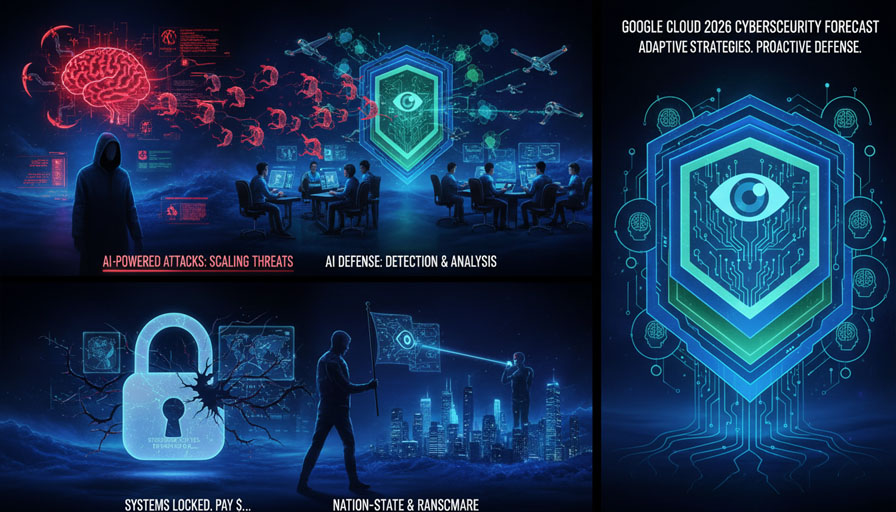
Google Cloud’s 2026 Cybersecurity Forecast highlights AI’s pivotal, dual role in both escalating cyberattacks and strengthening defenses. Alongside this, traditional threats like ransomware and nation-state activities are predicted to intensify, demanding a comprehensive and adaptive security posture from organizations.
Google Cloud’s newly released Cybersecurity Forecast for 2026 paints a clear picture of a rapidly evolving threat landscape. At the center of this transformation is artificial intelligence, which is expected to dramatically reshape both cyberattacks and cybersecurity defenses. According to the report, organizations are entering a phase where AI will no longer be optional in security strategies but an essential capability for survival.
AI Set to Supercharge Cyberattacks
The forecast warns that malicious actors will increasingly leverage AI to scale and refine their attacks. AI-powered tools are expected to generate highly convincing phishing campaigns, automate exploit discovery, and accelerate attack execution. As a result, even attackers with limited resources could deploy sophisticated campaigns that previously required advanced expertise.
This shift lowers the barrier to entry for cybercrime and overwhelms traditional, rule-based security systems. As AI-driven attacks grow in volume and complexity, organizations relying solely on legacy defenses may struggle to detect and contain threats before damage occurs.
AI Becomes Critical to Cyber Defense
At the same time, Google Cloud emphasizes that AI will be equally critical on the defensive side. Security teams are expected to deploy machine learning and behavioral analytics to detect anomalies, identify zero-day exploits, and respond to incidents in near real time. AI-powered Security Operations Centers (SOCs) can automate threat triage, prioritize risks, and significantly reduce response times.
This defensive use of AI allows organizations to move from reactive security models to proactive and predictive ones. By continuously learning from new data, AI systems can adapt to emerging threats faster than human-led processes alone.
Ransomware and Nation-State Threats Intensify
Beyond AI, the forecast highlights the continued dominance of ransomware as a major global threat. Attackers are expected to refine double-extortion tactics, combining data theft with encryption to increase pressure on victims. Critical infrastructure, healthcare systems, and supply chains remain high-value targets due to their operational sensitivity.
Nation-state cyber activity is also predicted to increase in both frequency and sophistication. As geopolitical tensions rise, state-sponsored groups are likely to intensify espionage, intellectual property theft, and disruptive cyber operations. These campaigns are often stealthy, persistent, and difficult to attribute, making them especially dangerous for governments and large enterprises.
Why Organizations Must Adapt Now
Google Cloud’s forecast makes one point unmistakably clear: cybersecurity strategies must evolve rapidly. Organizations need to invest in AI-driven defenses, strengthen ransomware resilience, and prepare for long-term nation-state threats. Equally important is building a culture of security awareness, continuous training, and cross-industry collaboration.
As 2026 approaches, cybersecurity is no longer just an IT concern. It is a board-level priority that directly impacts business continuity, trust, and long-term competitiveness. Those that adapt early will be far better positioned to withstand the increasingly complex cyber challenges ahead.
Source: The Hacker News














1 thought on “Google Cloud 2026 Cybersecurity Forecast Warns of AI-Driven Threats and Defenses”
Pingback: Google Pixel Warning: Critical System Update Could Trigger Black