
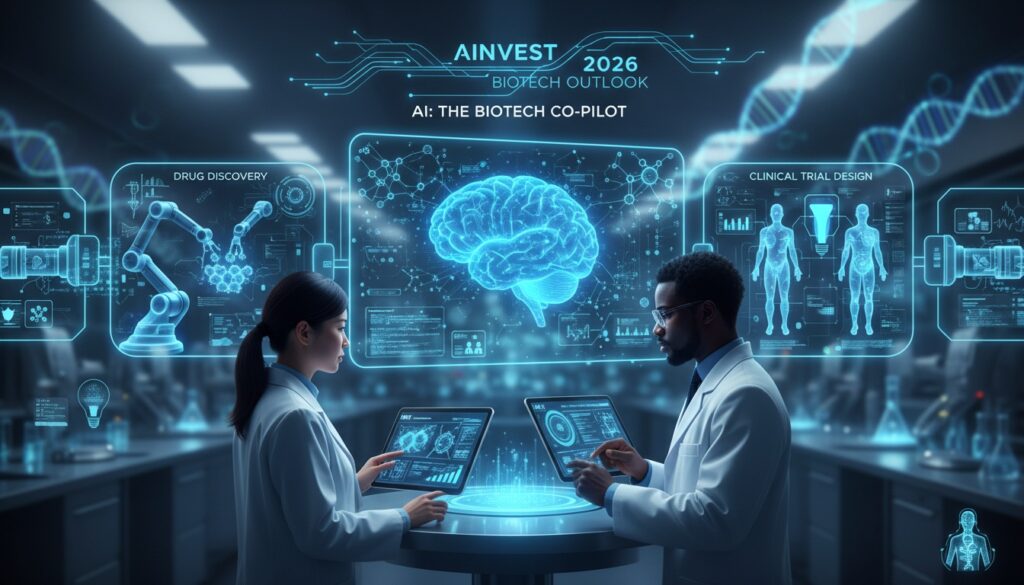
By 2026, AI will serve as biotech’s essential ‘co-pilot,’ dramatically accelerating drug discovery and advancing precision therapies. This integration promises faster development of life-saving drugs and highly personalized treatments, fundamentally transforming patient care.
The field of biotechnology is on the brink of a monumental shift. Specifically, artificial intelligence (AI) is set to redefine how we discover drugs. According to the AInvest 2026 Biotech Outlook, AI will become a crucial “co-pilot” for researchers. This change promises a new era of efficiency and personalized care. For more on the latest trends, visit our Future Tech category page.
Historically, drug discovery has been notoriously slow and expensive. Bringing a new medication to market often takes over a decade. However, AI changes this by stepping in at almost every stage. Machine learning algorithms can rapidly screen millions of potential compounds. Consequently, this role significantly compresses the early development phases. You can explore more about these algorithms in our Artificial Intelligence hub.
Revolutionizing the Laboratory with AI
AI’s real power lies in its ability to analyze vast biological datasets. These datasets are simply too large for humans to process alone. Therefore, the “AI co-pilot” identifies promising therapeutic targets far more quickly. Notably, it predicts molecular interactions with incredible accuracy. This allows scientists to concentrate on only the most viable candidates.
Moreover, these tools reduce the likelihood of late-stage failures. Because AI can model biological reactions, researchers avoid costly mistakes early on. This innovation is not just a futuristic concept; it is happening right now. At the same time, it lowers the financial barriers to entry for smaller biotech startups. As a result, we see a surge in specialized treatments for rare diseases.
Precision Therapies and Clinical Trial Optimization
Beyond the laboratory, AI’s influence extends deeply into clinical trials. Optimizing trial design is absolutely critical for delivering effective treatments swiftly. AI can analyze patient data to identify specific biomarkers. Consequently, this enables much more precise patient stratification for studies. This ensures trials are conducted with the most appropriate populations.
Furthermore, AI accurately matches patients to the correct therapy based on their genetic makeup. This is the essence of precision medicine. By doing so, clinicians significantly enhance treatment effectiveness. Meanwhile, unwanted side effects are minimized through better targeting. Therefore, patient safety increases while the duration of clinical testing decreases.
The Future of Personalized Patient Care
The promise of precision therapies is nothing short of revolutionary. Imagine treatments designed specifically for your unique genetic code and lifestyle. This personalized strategy holds the key to tackling difficult diseases. For instance, it could unlock new treatments for complex cancers and neurodegenerative conditions. As AI systems evolve, they will make healthcare increasingly predictive.
However, the widespread adoption of AI in biotech requires careful navigation. Key areas like data quality and regulatory frameworks must keep pace with technology. Ethical implications of AI-driven decisions in healthcare also demand scrutiny. Nevertheless, the trajectory for 2026 clearly indicates that AI will be the driving force. Ultimately, this integration is the absolute cornerstone of biotech’s future.
Conclusion
In conclusion, AI is transforming how we discover and deliver the next generation of medicines. From accelerating lab work to refining personalized treatments, its impact is undeniable. As we move forward, the collaboration between human expertise and AI power will save more lives. This shift represents a fundamental victory for global health and scientific innovation.
Source: Techaloop Editorial & StartUs Insights Biotech Trends.