

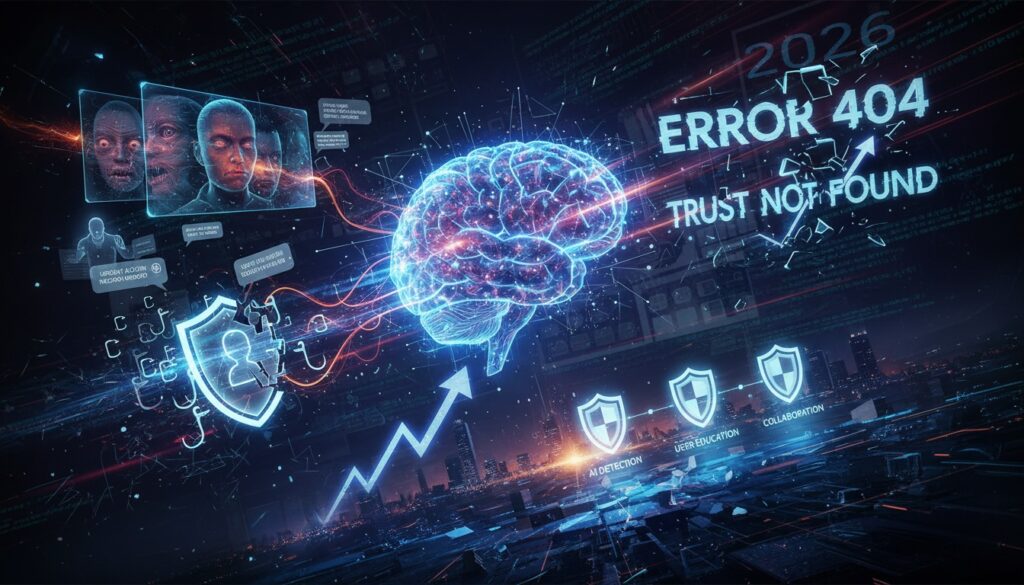
AI is rapidly transforming cyber threats, with deepfakes and advanced social engineering expected to surge by 2026. This shift risks a global digital trust crisis, forcing urgent action across technology, education, and regulation.
The digital world is approaching a critical inflection point. Artificial intelligence is no longer just enhancing productivity—it is also accelerating the evolution of cyber threats. According to cybersecurity analysts and industry reports, AI-powered social engineering, automated phishing, and hyper-realistic deepfakes could reach dangerous maturity levels by 2026. As a result, digital trust itself is now under serious threat.
For years, attackers have relied on social engineering to manipulate human behavior. However, AI has dramatically amplified these tactics. Today’s generative models can craft messages that are perfectly contextual, emotionally persuasive, and indistinguishable from legitimate communication. Consequently, phishing campaigns are no longer easy to detect. Instead, they are precise, scalable, and frighteningly effective.
At the same time, deepfake technology has evolved at an alarming pace. AI-generated audio and video can now convincingly replicate voices, facial expressions, and real-time interactions. This makes traditional verification methods unreliable. For example, a deepfake video call impersonating a CEO or public official could bypass internal controls and trigger devastating financial or reputational damage.
As these threats converge, digital trust begins to erode. When users can no longer trust emails, video calls, or even voice messages, the foundation of online commerce and communication weakens. Businesses face rising fraud risks, while individuals become more vulnerable to identity theft and financial exploitation. In short, the cost of uncertainty grows rapidly.
To counter this trend, organizations must act decisively. First, advanced AI-driven threat detection tools must become standard. In addition, stronger authentication methods—beyond passwords and SMS-based verification—are essential. Just as importantly, cybersecurity education must evolve. Users need training that includes deepfake awareness and emphasizes multi-channel verification for sensitive actions.
Looking ahead, governments, technology providers, and security teams must collaborate. Clear AI governance standards, ethical deployment frameworks, and cross-industry cooperation will play a vital role. If proactive measures are not taken soon, the digital ecosystem may enter an era where trust is the rarest commodity of all.
Source: securitymetrics.com