
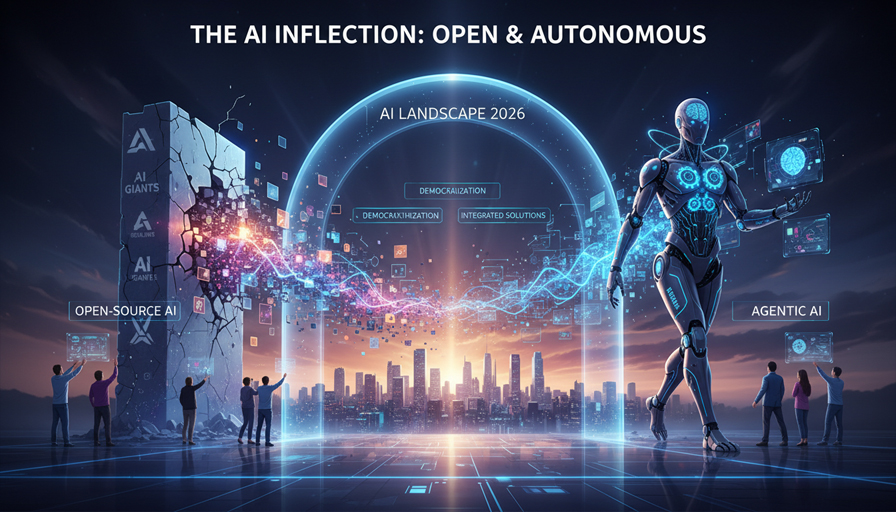
By 2026, open-source AI is set to challenge tech giants, while agentic AI, with its advanced autonomy, will drive innovation. This convergence promises a more accessible, powerful, and transformative AI landscape for all.
The world of artificial intelligence is about to change dramatically. Experts predict 2026 will mark a turning point. Two major trends are driving this shift: the rapid growth of open-source and agentic AI 2026 models and the rise of agentic AI. These trends will make advanced AI more accessible, speed up development, and change how we interact with smart systems.
The Rise of Open-source AI Models in 2026
Previously, cutting-edge AI development was dominated by a few well-funded companies. Their massive datasets, computing power, and elite talent created high barriers for newcomers. But in 2026, open-source and agentic AI 2026 models are expected to challenge this status quo. Collaborative efforts and rapid community feedback will help these models rival—and sometimes outperform—proprietary solutions. This shift will democratize powerful AI tools and spark global innovation, breaking the oligopoly of top tech firms.
The Emergence of Agentic AI
Agentic AI differs from traditional AI by acting with a higher degree of autonomy. These systems have memory, reasoning skills, and the ability to plan multi-step tasks independently. They can adapt to changing conditions. Imagine AI that researches a question, compiles information, and takes steps to achieve complex objectives. Applications range from smart personal assistants managing intricate schedules to autonomous agents optimizing business operations. Agentic AI can bring unprecedented efficiency to almost every industry.
Powerful Convergence: Open-source + Agentic AI
The combination of open-source and agentic AI is transformative. If agentic AI frameworks become open-source, developers worldwide could create customized applications and entirely new solutions. Startups and smaller businesses, previously limited by expensive proprietary models, will gain the tools to build sophisticated AI-powered products. This accessibility will accelerate adoption and shift focus from simple task automation to true intelligent autonomy. Learn more about AI trends on MIT Technology Review and Stanford AI Lab.
Preparing for the AI Revolution in 2026
By 2026, AI will not only be more powerful but also more widespread and adaptable. Challenges remain, such as ethical deployment, strong safety protocols, and responsible governance. Still, open-source and agentic AI breakthroughs signal an exciting new era. Businesses and policymakers must prepare for these changes. Understanding the strategic impact of this evolving AI ecosystem will be key to success. For research guidance, see NSF and OpenAI Research.
Source: nsf.gov