

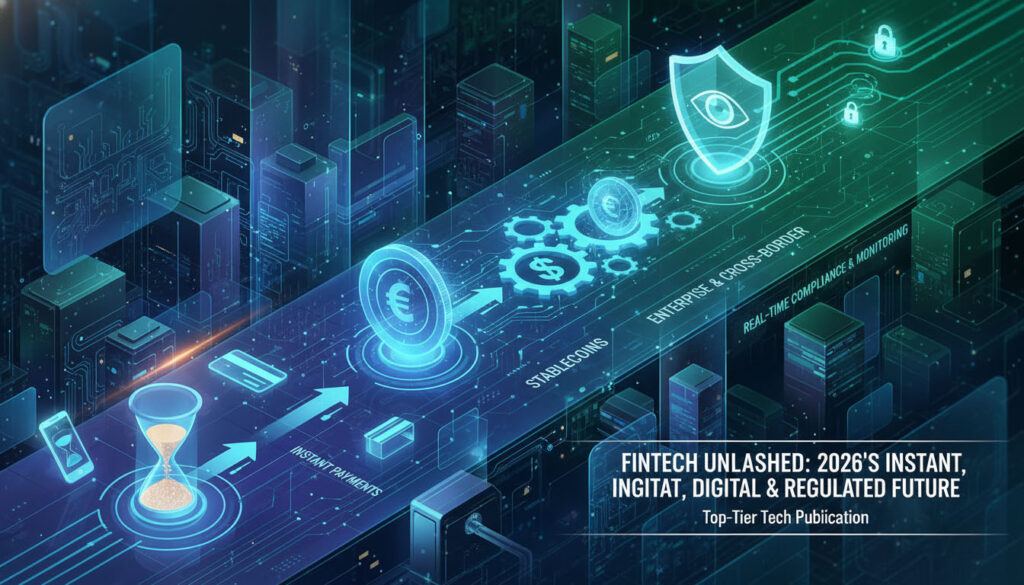
Executive Summary: By 2026, the fintech industry will transition from experimental disruption to operational maturity. Key shifts include the universal adoption of instant payment standards, the integration of stablecoins into corporate treasuries, and the rise of AI-driven real-time compliance.
The financial technology sector is currently moving beyond its experimental phase. By 2026, experts predict a definitive shift toward widespread, practical applications. This transformation will fundamentally reshape how businesses and consumers interact with money. Moreover, it consolidates advanced infrastructure into scalable solutions that impact the global economy.
One of the most profound changes involves the universal adoption of instant payments. Systems like FedNow and RTP are no longer peripheral tools for early adopters. Instead, they are becoming the go-to standard for payroll and treasury operations. Consequently, these systems enable immediate settlements and significantly improve liquidity management for companies worldwide.
The Rise of Enterprise Stablecoins
Stablecoins are also evolving rapidly beyond their origins in cryptocurrency markets. Previously, these assets were primarily used for speculative trading. However, they are now integrating into corporate and cross-border operations. Businesses utilize stablecoins to handle international remittances and supply chain financing more efficiently.
This shift is driven by a unique blend of price stability and blockchain transparency. Furthermore, new legislation like the GENIUS Act provides the necessary regulatory clarity. As a result, Fortune 100 companies are increasingly adopting regulated stablecoins for global treasury optimization. These digital assets reduce foreign exchange risks and streamline trade without the delays of legacy banking rails.
Real-Time Compliance and AI Oversight
The landscape of financial compliance is also undergoing a major overhaul. Traditionally, regulatory oversight was a backward-looking process. In contrast, 2026 will see the rise of real-time monitoring and enforcement. By harnessing AI and machine learning, institutions can now detect illicit activities with unprecedented precision.
Notably, this transformation requires substantial investment in “agentic” AI systems. These autonomous tools manage risks and policy enforcement across entire workflows. Because they operate in real-time, they enable proactive risk mitigation rather than reactive problem-solving. This shift builds greater trust in digital financial services while ensuring operational resilience.
A Hyper-Efficient Financial Future
The convergence of these trends paints a clear picture of the near future. We are entering an era defined by hyper-efficiency and seamless digital asset integration. For financial institutions, the message is clear: innovate or risk obsolescence. Meanwhile, businesses gain new avenues for operational speed and global reach.
For consumers, these advancements promise faster and more secure interactions. While the journey to 2026 involves complex technological hurdles, the direction is unmistakable. Fintech infrastructure is no longer just a disruptor. It has become the indispensable backbone of the modern global economy.