
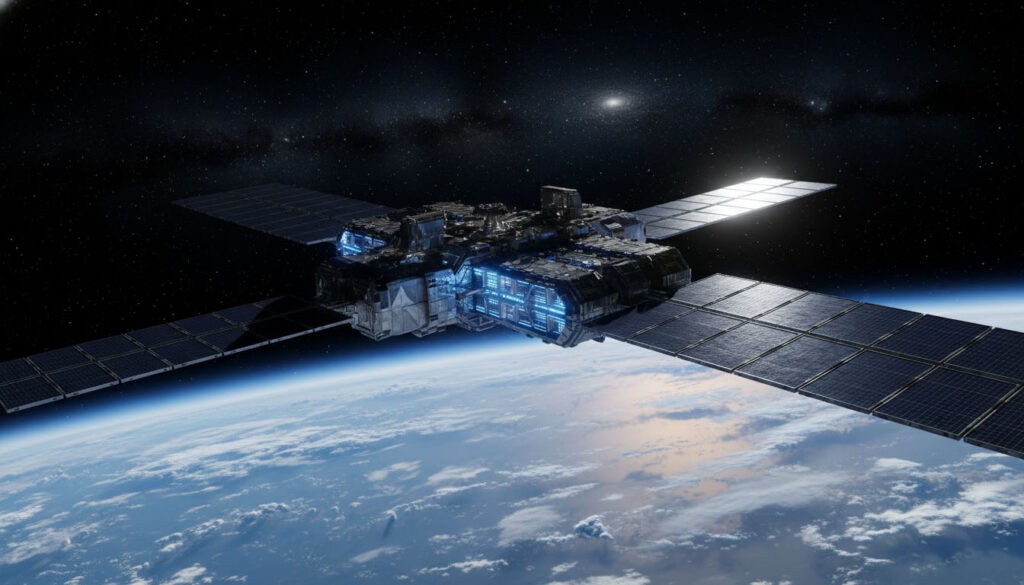
Tech giants like Google, SpaceX, and Blue Origin are racing to establish Orbital AI Data Centers in Earth’s orbit to meet AI’s insatiable power demands sustainably using abundant solar energy.
The ever-growing demands of artificial intelligence are constantly pushing the limits of our planet’s computational infrastructure. However, the next frontier for infrastructure isn’t on Earth. A new era is dawning beyond our terrestrial confines with the advent of Orbital AI Data Centers. Reports indicate that tech behemoths like Google, alongside space innovators SpaceX and Blue Origin, are ramping up efforts to establish Orbital AI Data Centers in space. This audacious move promises to revolutionize how we power and process the intelligent machines of tomorrow.
Why Tech Giants are Investing in Orbital AI Data Centers
The driving forces behind this monumental undertaking are sustainability and efficiency. Terrestrial Data Centers alternatives currently devour enormous quantities of electricity, contributing to global carbon emissions. These systems require energy-intensive cooling to manage the heat generated by powerful processors. Space offers a compelling alternative for Data Centers. Its natural vacuum provides an ideal cooling environment, while uninterrupted solar radiation presents a perpetual clean energy source. By positioning Data Centers in orbit, companies can harness solar power directly, mitigating the environmental footprint of generative AI development.
The Technology Powering Orbital AI Data Centers
For a long time, the idea of space-based computing felt like science fiction. Yet, progress in space-tech and reusable rocket technology has made this vision a reality. While specific details remain under wraps, the ambition for Data Centers signals a paradigm shift. Google seeks to leverage this orbital infrastructure for its advanced processing needs. SpaceX, with its groundbreaking Starship program, provides capabilities for lifting massive payloads, making the deployment of large-scale Data Centers practical. Similarly, Blue Origin is developing heavy-lift rockets to support the construction of these intricate systems.
Overcoming Challenges in Establishing Orbital AI Data Centers
The potential advantages are transformative. Imagine AI models operating with a minimal carbon footprint, powered endlessly by the sun. This could unlock possibilities for future-tech applications requiring ultra-low latency for space-based operations. However, the challenges for Data Centers are equally daunting. The cost involved in launching and maintaining sophisticated Orbital AI Data Centers in an unforgiving environment is astronomical. Factors like intense radiation and the constant threat of micro-meteoroids present formidable engineering obstacles. Moreover, the issue of space debris would be exacerbated by the addition of Data Centers. Connectivity speeds between these orbital hubs and Earth also pose a critical hurdle for Data Centers users.
Despite these obstacles, the competition to establish Data Centers underscores a fundamental realization: humanity’s digital future is linked to its energy future. By venturing into space, these giants aren’t just building faster computers; they are redefining sustainable, scalable AI infrastructure. The success of Orbital AI Data Centers could usher in a groundbreaking era of computing, fundamentally reshaping our relationship with the final frontier.
Source: biopharmaapac.com