

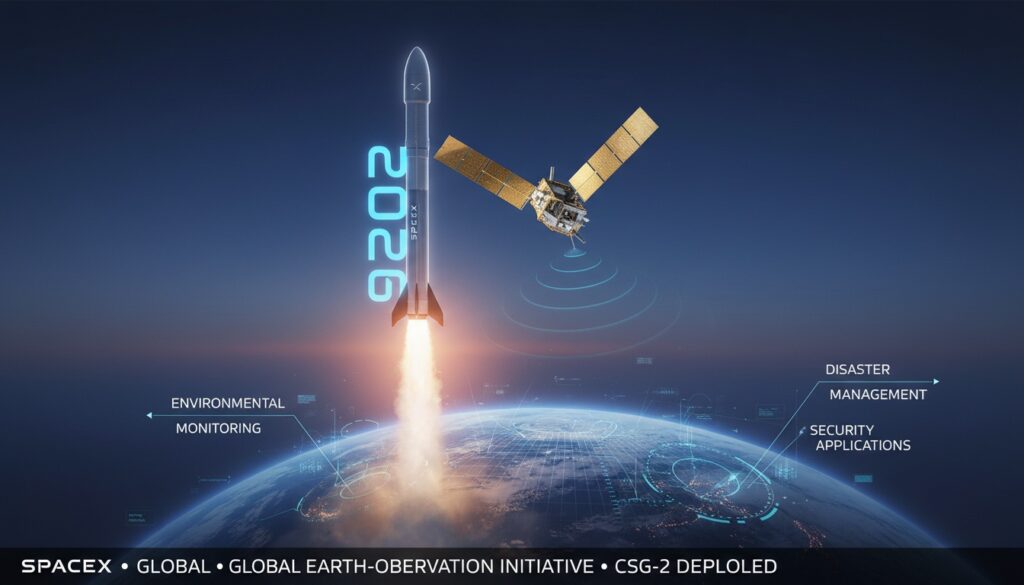
SpaceX kicked off 2026 with precision, successfully launching Italy’s COSMO-SkyMed Second Generation (CSG) Earth-observing satellite aboard a Falcon 9. This mission boosts global Earth observation, particularly with advanced radar imaging for environmental, disaster, and security applications.
SpaceX began its 2026 launch schedule with characteristic accuracy. Specifically, the private space giant successfully deployed a vital Italian Earth-observing satellite using its renowned Falcon 9 rocket. This mission marked the company’s first orbital endeavor of the year. For more on the latest advancements in aerospace, visit our Future Tech category page.
The Falcon 9 precisely placed the COSMO-SkyMed Second Generation (CSG) satellite into its designated orbit. Consequently, this achievement highlights SpaceX’s ongoing influence in supporting global space infrastructure. Because of these successes, the company appears ready for another record-breaking year of deployments. Reliable access to space remains a core tenet of their business model.
Advanced Radar Technology: The Power of CSG
The COSMO-SkyMed Second Generation satellite is a sophisticated system. Developed through a partnership between the Italian Space Agency (ASI) and the Ministry of Defense, it represents a substantial upgrade. Notably, the satellite features advanced Synthetic Aperture Radar (SAR) technology. Unlike optical cameras, SAR systems can image the Earth’s surface in any weather condition.
Moreover, SAR emits its own microwave signals instead of relying on sunlight. Therefore, it provides an unparalleled view of our planet even during the night or through thick cloud cover. This capability is essential for regions prone to frequent storms. By using high-resolution radar data, Italy significantly enhances its independent Earth observation capabilities. At the same time, it provides valuable data to the global scientific community.
Critical Applications: Environment and Security
The applications for CSG data are extensive and crucial for numerous sectors. In environmental monitoring, this data is invaluable for tracking subtle ecosystem changes. For example, researchers use it to monitor melting ice caps and glacier movements. Consequently, these observations provide essential input for climate change research and conservation efforts.
Furthermore, the satellite plays a critical role in national security. The all-weather reconnaissance offered by CSG is vital for maritime surveillance and border control. It bolsters Italy’s autonomous capabilities in strategic intelligence gathering. Meanwhile, the technology helps track oil spills and land deformation with extreme precision. As a result, authorities can respond faster to environmental threats.
Humanitarian Aid and Disaster Response
Beyond security, CSG is a game-changer for humanitarian efforts. Its rapid imaging capabilities enable quick assessments after natural disasters. For instance, it can map damage after earthquakes, tsunamis, or widespread flooding. Therefore, emergency responders receive vital information to coordinate relief efforts effectively.
Because the satellite can “see” through smoke and clouds, it is particularly useful during volcanic eruptions or wildfires. This real-time intelligence saves lives by identifying safe routes for rescue teams. As demand for such data grows, the reliance on launch providers like SpaceX becomes even more indispensable. Truly, space technology is now a fundamental tool for disaster management.
Conclusion: A Promising Course for 2026
In conclusion, the successful deployment of the CSG satellite confirms SpaceX’s operational expertise. This initial success sets a promising course for the company’s 2026 manifest. As the global reliance on advanced space technology grows, we expect more ambitious missions in the coming months. Ultimately, this launch reinforces the fact that reliable space access drives both scientific progress and practical security for everyone on Earth.
Source: Techaloop Editorial & Spaceflight Now Mission Reports.