

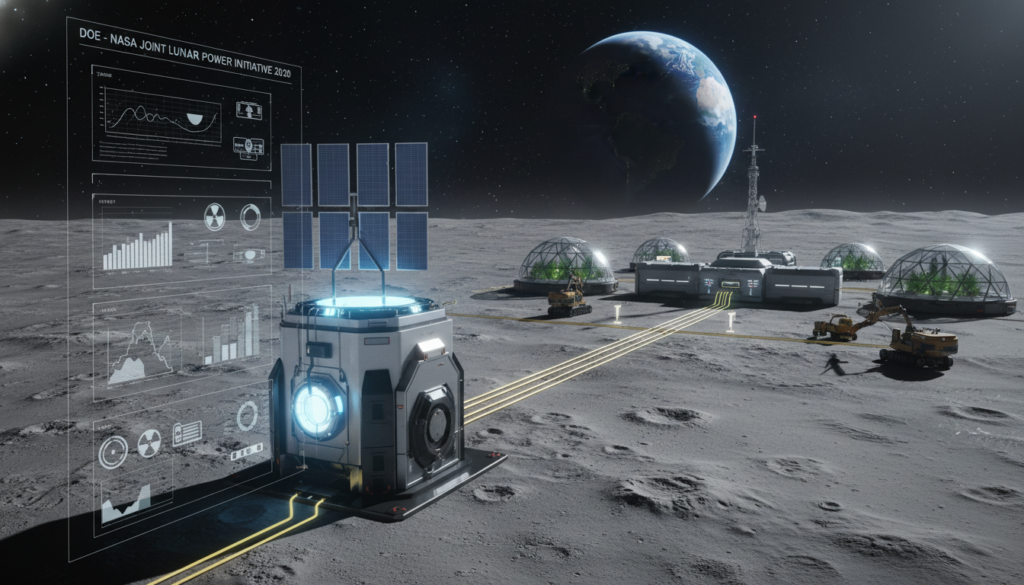
NASA and the Department of Energy are jointly committing to deploy a nuclear fission power system on the Moon by 2030. This ambitious project seeks to provide continuous, abundant energy, revolutionizing long-duration lunar and Martian missions.
Imagine a future where humans live and work on the Moon. They stay not just for days, but for years. This vision is now closer to reality. The U.S. Department of Energy (DOE) and NASA recently made a landmark announcement. Consequently, they have committed to a Lunar Fission Surface Power System by 2030.
This initiative represents more than a technical achievement. Furthermore, it is a pivotal leap for space exploration. It promises the consistent energy needed for sustained human presence. Additionally, it paves the way for future expeditions to Mars.
Overcoming Lunar Energy Limitations
Space missions have been tethered by power limits for too long. Solar panels are common but have significant flaws. For instance, they go dark during the brutal two-week lunar night. Moreover, they fail in perpetually shadowed regions containing water ice. Radioisotope thermoelectric generators (RTGs) offer reliability. However, they provide too little power for a bustling lunar base.
Therefore, a compact fission reactor is essential. It is designed to smash through these limitations. Ultimately, the Lunar Fission Surface Power System offers a game-changing solution. It works tirelessly, regardless of sunlight availability.
powering the Artemis Program
This cutting-edge fission system supports NASA’s ambitious Artemis program. The program aims to establish a lasting human presence on the Moon. A steady power supply is absolutely vital. It powers astronaut habitats and life support systems. Furthermore, it fuels advanced scientific experiments. Crucially, it charges exploration rovers for extended missions.
Most importantly, it enables in-situ resource utilization (ISRU). Imagine extracting water ice for rocket fuel. Alternatively, systems could produce breathable air directly from the Moon. ISRU is key to making Space Tech settlements affordable. Consequently, this reduces reliance on supplies from Earth.
Strategic Collaboration and Design
The collaboration between the DOE and NASA is a masterstroke. The DOE possesses unparalleled expertise in nuclear science. Meanwhile, NASA is a titan in space systems. The DOE’s Idaho National Laboratory has led reactor design for decades. They bring invaluable knowledge to this project. The system must be rugged enough for space travel. Additionally, it must be safe for lunar deployment.
The goal is a small, modular reactor. It can be launched and delivered to the Moon effectively. Once there, it activates with minimal human help. Subsequently, it generates kilowatts of electricity for decades. This level of innovation drives Future Tech forward substantially.
Implications for Mars and Beyond
The success of a Lunar Fission Surface Power System extends beyond the Moon. It dramatically influences future Mars missions. The Red Planet presents even tougher power hurdles. For example, it has a dusty atmosphere. Furthermore, its distance from the Sun reduces solar efficiency. A proven nuclear solution empowers Martian explorers significantly.
It enables extensive scientific investigations. Moreover, it supports permanent human outposts. These advancements align with broader goals in Greentech and Sustainability for extreme environments. Resource utilization projects become feasible with reliable power.
The Road to 2030
Committing to a 2030 deadline is audacious. It highlights the profound urgency of this capability. However, significant technical challenges loom ahead. These include miniaturization and radiation shielding. Additionally, heat rejection in a vacuum is difficult. Yet, the combined might of NASA and DOE is promising.
This initiative is on a solid path to success. Continuous power is an absolute prerequisite for the future. Finally, this project marks a monumental stride. It unlocks the full potential of lunar exploration. For more details on these initiatives, visit NASA or the Department of Energy.















2 thoughts on “NASA and DOE Target 2030 for Lunar Fission Surface Power System”
Pingback: Lenovo Unveils Yoga Solar PC at MWC 2025, Introducing Self-Po...
Pingback: Batteryless IoT Devices Are Powering a More Sustainable Digital...