

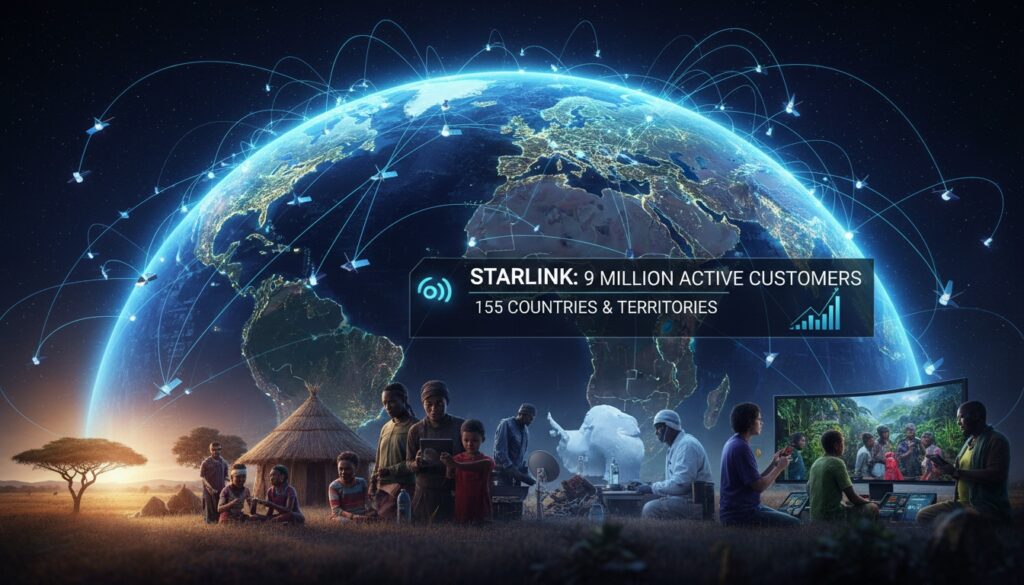
Starlink now serves over 9 million customers across 155 countries, solidifying its leadership in satellite internet. This rapid global expansion delivers vital high-speed connectivity, bridging the digital divide for countless users.
Starlink, SpaceX’s satellite internet venture, has reached a major global milestone. The company now delivers broadband connectivity to more than 9 million customers across 155 countries and territories, firmly positioning itself as the world’s leading low Earth orbit (LEO) satellite internet provider.
This rapid expansion highlights Starlink’s growing influence on global connectivity, particularly in regions that traditional broadband networks struggle to reach.
Starlink Global Expansion Drives Satellite Internet Adoption
Starlink continues to scale quickly by deploying thousands of compact satellites into low Earth orbit. This aggressive rollout enables the network to provide high-speed, low-latency internet to rural communities, maritime users, disaster zones, and remote locations worldwide.
Unlike legacy satellite services that suffer from high latency, Starlink’s LEO architecture delivers a responsive, fiber-like experience. Users benefit from smoother video calls, faster downloads, and reliable real-time connectivity.
As a result, Starlink plays a critical role in narrowing the global digital divide, especially in underserved and emerging markets.
Subscriber Growth Signals Rising Demand for Space-Based Connectivity
Since launching its public beta, Starlink has experienced sustained and accelerating subscriber growth. Millions of users now rely on the service for remote work, online education, business operations, and everyday communication.
The reported 9 million customer figure likely represents a far larger total user base. Households, enterprises, schools, and public institutions often connect multiple users through a single Starlink terminal.
By securing regulatory approvals across 155 countries and territories, Starlink has unlocked new markets at an unprecedented pace and continues to expand its global footprint.
Low Earth Orbit Technology Gives Starlink a Competitive Advantage
Starlink’s low Earth orbit satellite constellation sits at the core of its technical advantage. Operating much closer to Earth than geostationary satellites, the network significantly reduces signal latency and improves overall performance.
SpaceX regularly launches additional satellites aboard Falcon 9 rockets, expanding network capacity and strengthening service reliability for existing users.
This technological leadership places Starlink at the forefront of innovation within the Networking & Edge Computing ecosystem.
Starlink’s Market Impact Intensifies Industry Competition
Starlink’s rapid growth continues to reshape the global telecommunications landscape. Its success has accelerated development timelines for competitors such as Amazon’s Project Kuiper and OneWeb, now part of Eutelsat.
This growing competition benefits consumers by driving improvements in service quality, coverage, and long-term pricing across the satellite broadband sector.
Ongoing industry analysis from Space.com regularly highlights how satellite constellations are transforming global internet infrastructure.
Challenges and the Road Ahead for Starlink
Despite its momentum, Starlink still faces several challenges. Hardware costs and subscription pricing remain barriers for some users, particularly in lower-income regions.
The company also addresses concerns related to orbital congestion, space debris, and the impact of large satellite constellations on astronomical research. Starlink continues to develop mitigation strategies to reduce these effects.
Looking ahead, next-generation satellites, including larger Gen2 models expected to launch aboard SpaceX’s Starship, will significantly expand network capacity. As Starlink refines its technology and broadens coverage, it will play an increasingly central role in shaping the future of global internet access.















1 thought on “Starlink Surpasses 9 Million Users Across 155 Countries, Expanding Global Satellite Internet Reach”
Pingback: SpaceX 2026 Kickoff: Falcon 9 Launches Italy's COSMO-SkyMed...