


Most skilled professionals do not have an income problem. They have a visibility problem.
Many freelancers, consultants, developers, designers, SEO specialists, virtual assistants, and technical professionals share the same frustration.
They spend months improving their skills, completing courses, building portfolios, and collecting certifications. Yet clients continue hiring other people who often appear less experienced.
The uncomfortable reality is that clients rarely buy skill alone. They buy clarity, trust, visibility, and confidence.
Direct Answer: If you want to get your first client, focus less on acquiring additional skills and more on becoming visible to the right audience. Position your expertise clearly, build trust signals, conduct targeted outreach, and create a repeatable client acquisition process. Most professionals struggle because potential clients never discover them, understand them, or trust them enough to hire.
The Real Reason Skilled People Stay Broke
Most people assume a lack of clients means a lack of skill.
In practice, many skilled professionals remain underpaid while less experienced competitors generate consistent income.
The difference is often visibility rather than capability.
Clients cannot hire someone they cannot find. They cannot trust someone they do not understand. They cannot buy from someone who appears identical to dozens of alternatives.
This creates a frustrating cycle:
- Learn more skills
- Build a better portfolio
- Wait for clients
- Receive little or no response
- Assume more learning is required
- Repeat the cycle
The result is what many professionals experience as being “skilled but broke.”
Why Clients Ignore Your Portfolio
A portfolio is not a client acquisition system.
Many freelancers believe clients actively search portfolios and compare technical quality.
Most clients do not.
Clients typically evaluate three questions:
- Can this person solve my problem?
- Can I trust them?
- Can they explain the solution clearly?
A portfolio filled with screenshots or project samples may demonstrate ability, but it often fails to answer those questions.
That is why many talented professionals receive little attention despite producing excellent work.
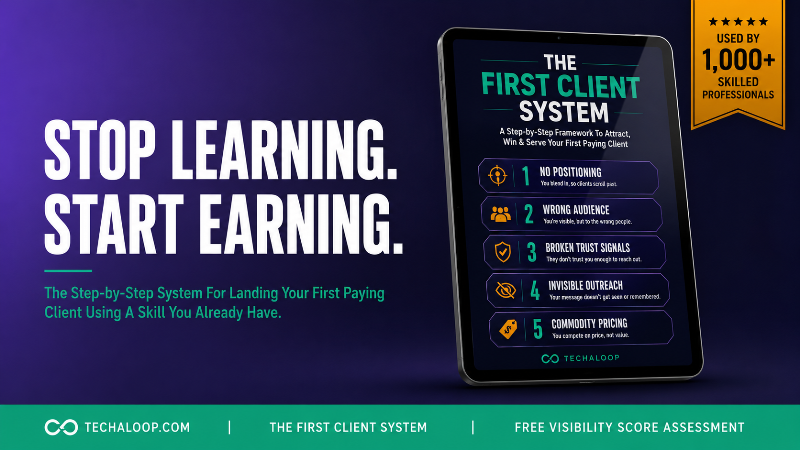
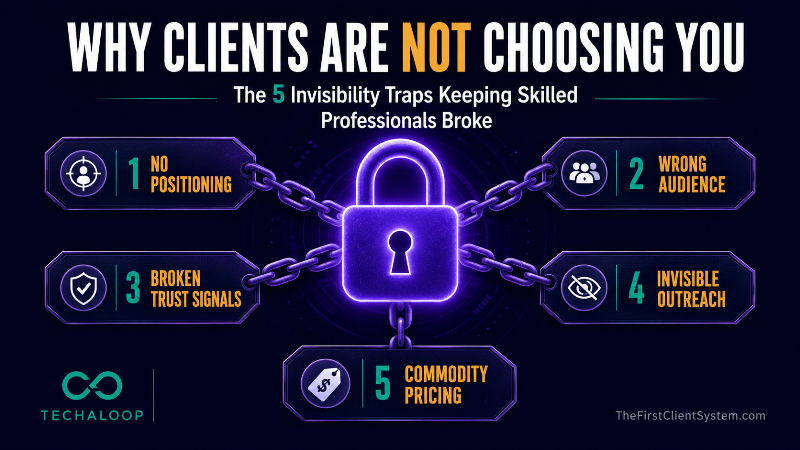
The 5 Invisibility Traps That Prevent Clients From Hiring You
After analyzing common freelancer struggles, five recurring patterns appear repeatedly.
Trap 1: No Positioning
Many professionals describe themselves using broad labels.
Examples include:
- Web Developer
- SEO Expert
- Graphic Designer
- Virtual Assistant
- Programmer
The problem is that clients rarely search for generic labels.
They search for outcomes.
A positioning statement such as “I help local service businesses generate more leads through conversion-focused websites” creates far more clarity than simply saying “web designer.”
Trap 2: Wrong Audience
Many freelancers attempt to serve everyone.
The wider the audience becomes, the harder it becomes for potential clients to recognize relevance.
Specific audiences create stronger opportunities.
Examples include:
- Law firms
- Real estate agencies
- E-commerce stores
- Healthcare providers
- SaaS companies
Trap 3: Broken Trust Signals
Trust is often more important than skill during early buying decisions.
Trust signals may include:
- Professional profiles
- Case studies
- Testimonials
- Public content
- Industry expertise
- Educational resources
Without trust signals, prospects hesitate.
Trap 4: Invisible Outreach
Many freelancers wait for opportunities instead of creating them.
Visibility requires activity.
Clients frequently come from:
- Direct outreach
- Networking
- Referrals
- Content marketing
- Communities
- Strategic partnerships
Waiting alone is rarely an acquisition strategy.
Trap 5: Commodity Pricing
When positioning is weak, pricing becomes the only comparison point.
Clients begin comparing providers based on cost rather than value.
This creates constant pressure to lower prices.
Strong positioning reduces this problem because clients compare outcomes rather than hourly rates.

The First Client Framework
Getting a first client becomes easier when viewed as a system instead of a random event.
| Stage | Objective |
|---|---|
| Positioning | Clarify who you help and what result you create |
| Trust | Reduce perceived risk |
| Visibility | Become discoverable |
| Outreach | Start conversations |
| Conversion | Turn interest into paid work |
Step 1: Create a Positioning Statement
A strong positioning statement answers four questions:
- Who do you help?
- What problem do you solve?
- How do you solve it?
- What outcome do clients receive?
Example:
“I help local businesses generate more qualified leads by improving website conversion rates and search visibility.”
This is far more persuasive than simply saying “SEO specialist.”
Step 2: Build Minimum Viable Trust
You do not need hundreds of testimonials to land your first client.
You need enough evidence to reduce uncertainty.
Examples include:
- Personal projects
- Sample work
- Audit reports
- Process demonstrations
- Educational content
- Volunteer projects
Clients often buy confidence before they buy expertise.
Step 3: Become Visible Where Clients Already Gather
Visibility improves when you participate in places where your audience spends time.
Examples may include:
- Industry communities
- Facebook groups
- Professional forums
- Slack communities
- Local business networks
The objective is not promotion.
The objective is relevance and familiarity.
Step 4: Use Targeted Outreach
Many professionals fear outreach because they assume it means aggressive selling.
Effective outreach focuses on identifying opportunities and starting conversations.
A simple structure often works:
- Identify a business problem.
- Provide a useful observation.
- Suggest an improvement.
- Invite discussion.
For example, a web designer might identify a broken conversion path on a business website and offer a practical suggestion.
This approach creates value before asking for anything.
Step 5: Make It Easy To Buy
Many first-time freelancers unintentionally create complexity.
Clients should understand:
- What you offer
- Who it is for
- Expected outcomes
- Pricing approach
- Next steps
Confused prospects rarely become clients.
Common Mistakes That Delay Your First Client
- Taking endless courses instead of seeking opportunities
- Targeting everyone
- Waiting for referrals before building visibility
- Sending generic outreach messages
- Competing only on price
- Ignoring trust signals
- Building a portfolio without context
- Expecting clients to appear automatically
- Avoiding conversations because of fear of rejection
- Failing to follow up consistently
What To Do If You Have No Experience
Lack of paid experience does not automatically prevent client acquisition.
The larger challenge is demonstrating capability.
Consider creating:
- Sample projects
- Mock client work
- Industry audits
- Process breakdowns
- Educational content
Many first clients are secured because the freelancer demonstrated understanding rather than extensive experience.
How Different Skills Can Get Their First Client
Web Designers
Identify websites with usability, speed, or conversion issues and provide specific improvement recommendations.
SEO Specialists
Create mini SEO audits showing missed opportunities and present actionable fixes.
Copywriters
Rewrite weak headlines, landing pages, or emails and demonstrate potential improvements.
Programmers
Identify inefficient workflows and propose simple automation or development solutions.
Virtual Assistants
Show how operational bottlenecks can be reduced through better systems and organization.
Why Visibility Matters More Than Another Course
Education has value.
Additional learning can improve outcomes.
The problem occurs when education becomes a substitute for execution.
Many professionals already possess enough skill to help someone today.
What they lack is a structured method for becoming visible to buyers.
Learning increases capability. Visibility creates opportunity.
How To Create Predictable Client Acquisition
The goal is not simply getting one client.
The goal is building a repeatable system.
A basic weekly process may include:
- Publish useful insights
- Improve trust assets
- Contact potential prospects
- Follow up consistently
- Track conversations
- Refine positioning
Over time, client acquisition becomes less dependent on luck and more dependent on process.
Frequently Asked Questions
How long does it take to get a first client?
The timeline varies based on positioning, outreach volume, market demand, and consistency. Some professionals secure opportunities quickly, while others require several months of systematic effort.
Do I need a website before getting clients?
No. A website can help, but clear positioning, trust signals, and outreach are often more important during the early stages.
Can I get clients without using Upwork?
Yes. Many freelancers acquire clients through direct outreach, referrals, networking, content creation, partnerships, and professional communities.
Should I lower my prices to get my first client?
Lower pricing can sometimes reduce barriers, but competing solely on price often creates long-term problems. Focus on value and clarity first.
What if nobody responds to my outreach?
Review your positioning, targeting, message quality, and offer relevance. Low response rates often indicate a messaging or audience mismatch rather than a skill problem.
Conclusion
The biggest obstacle for many skilled professionals is not capability.
It is invisibility.
Clients hire people they can find, understand, and trust.
If you focus on positioning, trust signals, visibility, outreach, and conversion, your first client becomes significantly more achievable.
The deeper challenge is transforming those activities into a repeatable system. That is where frameworks such as the First Client System become valuable because they turn scattered tactics into a structured client acquisition process.