
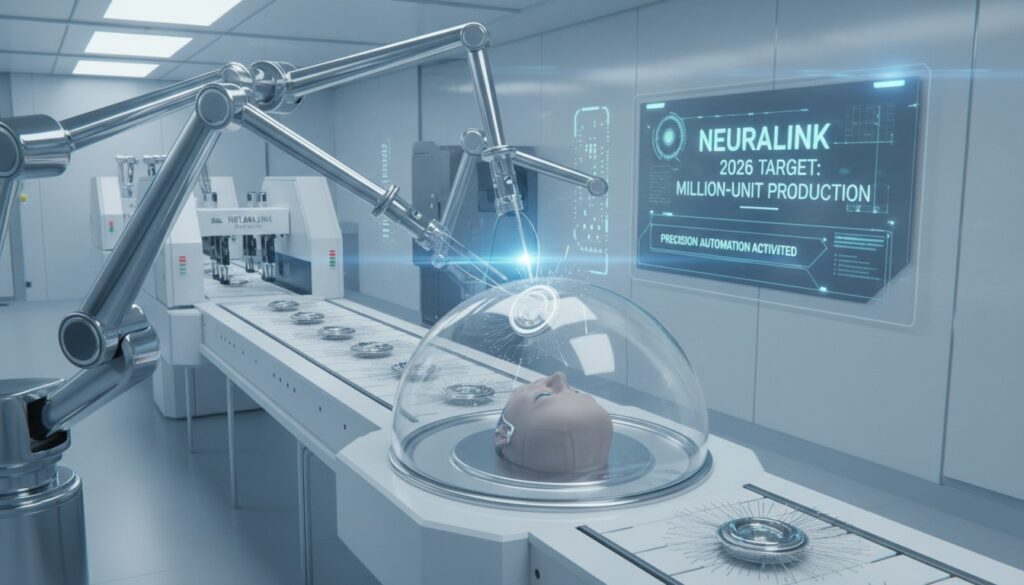
Neuralink is aiming for mass-produced brain implants and automated surgery by 2026. This ambitious goal, following successful human trials, underscores its commitment to widespread accessibility and revolutionizing neurological treatment, despite significant challenges.
Elon Musk’s neurotechnology firm, Neuralink, has unveiled an incredibly ambitious vision for 2026. Specifically, the company plans to ramp up production of its groundbreaking brain implants. At the same time, it aims to automate the intricate surgical procedures required for installation. For more on the future of high-tech medicine, visit our Future Tech category page.
This bold announcement follows a critical milestone of successful human implantations. Consequently, this marks a pivotal moment for both the firm and the broader field of brain-computer interfaces (BCIs). The achievement validates the technology and offers hope to individuals with severe neurological conditions. You can track similar technological shifts in our AI section.
The Road to High-Volume Production
Neuralink’s journey features remarkable scientific leaps and bold pronouncements. After years of development, the company celebrated the successful integration of its “Link” device into human patients. This achievement allows individuals to control external devices with their thoughts alone. Meanwhile, the initial outcomes from these trials have captivated the global scientific community.
The strategic move toward high-volume production signals an intent to leave the experimental phase. Currently, implanting these delicate devices is a time-intensive process. Therefore, specialists are required to perform every single procedure manually. By pursuing automated methods, Neuralink aims to streamline this complex installation. As a result, the scalability of its operations will increase dramatically by 2026.
Automated Surgery and Precision Robotics
By pursuing automation, Neuralink aims to minimize the potential for human error. This level of precision is essential for meeting the demands of widespread adoption. Specifically, the company is developing robotics capable of safely inserting threads into the human brain. This would drastically reduce costs and expand access to life-changing technology. Consequently, a much larger patient population could benefit from these treatments.
However, achieving these targets will necessitate overcoming significant technical hurdles. Developing robots with this degree of precision is an undertaking of immense complexity. Furthermore, ensuring long-term reliability at a mass scale requires exhaustive testing. Therefore, the company must work closely with stringent regulatory bodies to ensure patient safety remains the top priority. That said, the potential rewards for medical science are truly unprecedented.
Ethical Considerations and Mainstream Adoption
As the technology inches closer to mainstream availability, ethical concerns will likely intensify. Specifically, data privacy and security remain at the forefront of the conversation. Many experts also worry about the potential for human augmentation beyond medical necessity. Therefore, robust regulatory frameworks are needed to manage these sensitive issues. Neuralink must navigate these social challenges while continuing its rapid engineering pace.
Should the firm succeed, it could fundamentally reshape the world of neurosurgery. The capability to robotically implant BCIs would usher in a new era of human-computer interaction. While the path ahead is undoubtedly complex, the aggressive timeline underscores a deep commitment to innovation. Ultimately, these objectives aim to address debilitating conditions and revolutionize how humans interact with technology.
Conclusion: A New Era for Neural Health
In conclusion, Neuralink is pushing the boundaries of what is possible in neurotechnology. The vision for 2026 represents a massive leap toward making brain implants accessible to everyone. By combining mass production with robotic precision, the company seeks to transform medical care globally. Truly, this initiative could change the lives of millions by restoring functionality through the power of the human mind.
Source: Techaloop Editorial & Vavoza Technology Insights.