
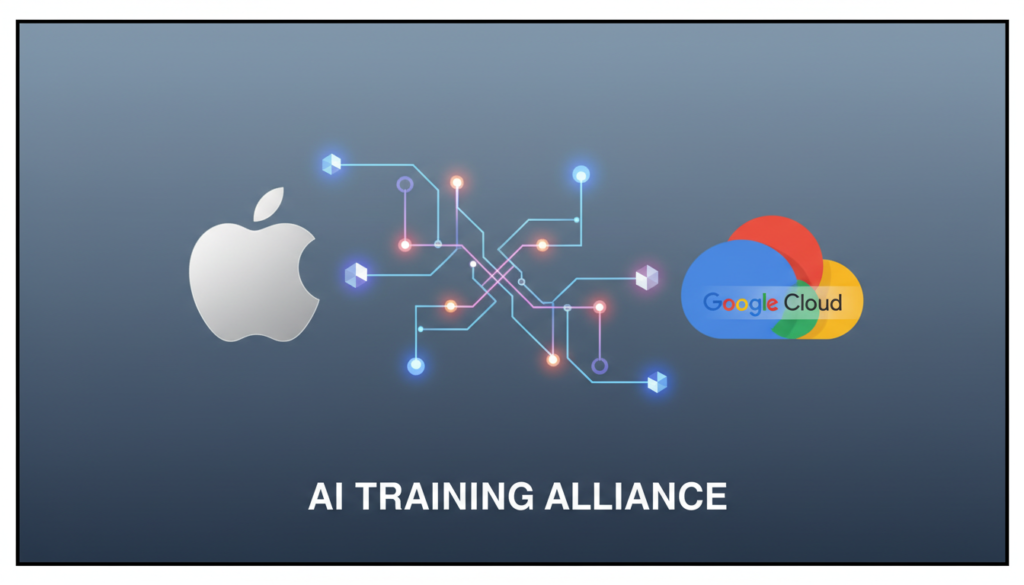
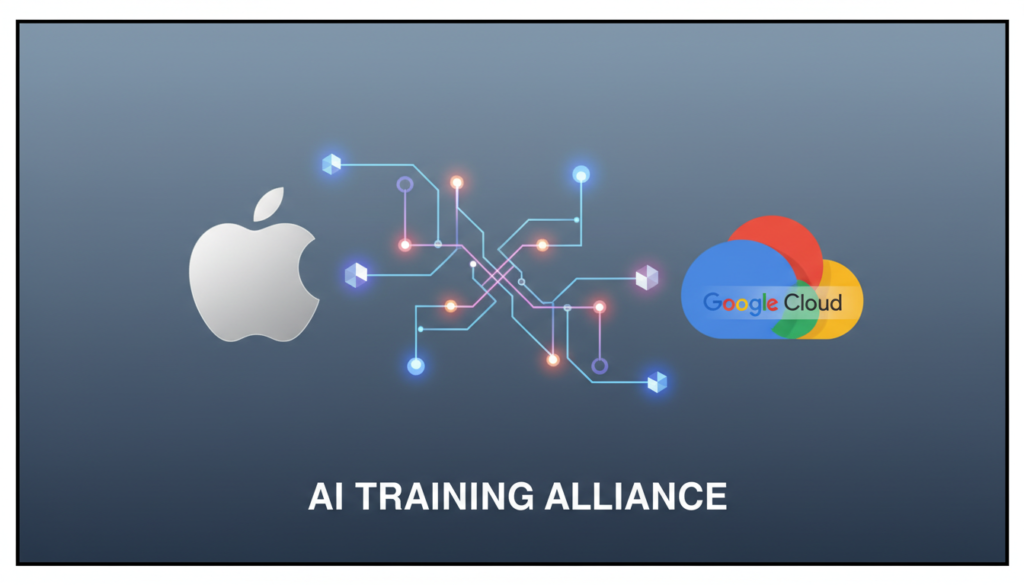
Apple is reportedly leveraging Google Cloud’s TPUs for training its next-generation Siri AI, a surprising collaboration that signals a pragmatic shift in strategy. The move prioritizes access to advanced compute infrastructure to accelerate Siri’s development as competition in AI assistants intensifies.
Apple is reportedly utilizing Google Cloud’s Tensor Processing Units (TPUs) to train components of its upcoming conversational Siri AI system. If accurate, this development represents a notable moment in Silicon Valley, linking two long-standing competitors through shared artificial intelligence infrastructure. The reported Apple Google Cloud TPU training arrangement reflects a pragmatic recalibration rather than a philosophical shift, with Apple prioritizing performance, scalability, and time-to-market in a rapidly evolving AI landscape.
For decades, Apple has been synonymous with vertical integration. The company carefully designs and controls its hardware, software, and silicon stack, from iPhone chips to operating systems and core services. Siri, introduced in 2011, has long embodied this closed-loop philosophy. However, as conversational AI has advanced dramatically, the limitations of purely internal infrastructure have become increasingly visible.
In recent years, Siri has faced growing criticism for lagging behind rivals in conversational depth, reasoning ability, and contextual awareness. Meanwhile, breakthroughs in generative AI have reset user expectations. Modern assistants are now expected to understand nuance, maintain long conversations, and adapt dynamically to user intent. Achieving this level of intelligence requires training massive models on enormous datasets, a process that demands unprecedented computational resources.
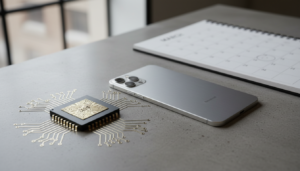
This is where Google’s TPUs enter the picture. Designed specifically for large-scale machine learning workloads, TPUs offer high-throughput matrix processing optimized for training and inference. Google has relied on these accelerators internally for years to power its own AI systems. By reportedly tapping into this infrastructure via Google Cloud, Apple gains access to mature, battle-tested AI compute without waiting years to scale equivalent capacity internally.
Importantly, this reported collaboration does not suggest Apple is abandoning its silicon roadmap. Rather, it highlights the sheer scale and urgency of modern AI development. Training frontier models is no longer simply a matter of owning capable chips; it requires vast clusters, optimized interconnects, and software ecosystems refined through years of production use. The Apple Google Cloud TPU training approach allows Cupertino to bypass near-term bottlenecks while maintaining strategic flexibility.
Strategic Implications for Siri Apple Google Cloud TPU training
If the reports are accurate, the implications for Siri’s evolution are significant. Leveraging external TPU infrastructure could compress development timelines and enable Apple’s AI teams to iterate faster on large language and multimodal models. This acceleration is critical as the competitive landscape becomes increasingly crowded, with assistants from Google, OpenAI, Microsoft, and others setting aggressive performance benchmarks.
A more capable Siri would not only improve voice interactions but could also integrate more deeply across Apple’s ecosystem. Enhanced reasoning and contextual understanding would enable richer automation, smarter on-device suggestions, and more natural cross-app workflows. In the broader artificial intelligence race, catching up is no longer optional for Apple—it is a strategic necessity.
However, this reported move also raises sensitive questions. Apple has long positioned itself as a privacy-first company, emphasizing on-device processing and minimal data exposure. Utilizing a competitor’s cloud infrastructure inevitably invites scrutiny, particularly around data handling and sovereignty. While enterprise-grade security controls and isolation mechanisms are standard in modern cloud platforms, public perception matters as much as technical safeguards.
From a risk perspective, Apple is likely using Google Cloud TPUs strictly for model training rather than live inference. Training workloads typically rely on curated, anonymized, or synthetic datasets, reducing exposure to real user data. Nonetheless, the situation underscores the complex trade-offs facing companies operating at the frontier of AI while maintaining strong commitments to cybersecurity and privacy.
Why Google Cloud TPUs Matter in Apple Google Cloud TPU training
Google Cloud’s TPUs are purpose-built accelerators optimized for neural network workloads. Unlike general-purpose GPUs, TPUs are engineered around tensor operations, enabling higher efficiency for large-scale training tasks. Over multiple generations, Google has refined TPU architecture to support increasingly complex models with improved energy efficiency and scalability.
By offering TPUs as a cloud service, Google effectively monetizes its internal AI infrastructure expertise. For companies like Apple, this presents an attractive option: immediate access to high-performance training environments without the capital expenditure and operational complexity of building equivalent systems from scratch. In an era where AI infrastructure costs are measured in billions, strategic outsourcing becomes a rational, not ideological, decision.
More broadly, the reported Apple Google Cloud TPU training relationship reflects a growing trend across the industry. Even the most resource-rich technology companies are reevaluating how much AI infrastructure they can realistically build alone. The result is a more interconnected ecosystem where competition and cooperation increasingly coexist.
Industry-Wide Challenges
This reported collaboration highlights the structural challenges facing the AI sector. Training cutting-edge models requires not only advanced hardware but also specialized software stacks, networking, and operational expertise. Maintaining this at scale is extraordinarily expensive, even for trillion-dollar companies.
As a result, the industry may see more partnerships that once seemed unthinkable. Cloud providers with mature AI infrastructure are becoming central enablers, while platform companies focus on differentiation at the product and ecosystem level. The Apple Google Cloud TPU training narrative fits squarely into this emerging pattern.
From a competitive standpoint, this does not diminish Apple’s long-term ambitions. Instead, it reflects an industry reality: no single company can dominate every layer of the AI stack simultaneously without strategic compromises.
Why This Matters for the AI Assistant Race
The reported use of Google Cloud TPUs for Siri training underscores how quickly the AI assistant race is evolving. Performance gaps that once took years to close can now define platform relevance within months. Access to scalable compute is therefore becoming as critical as model architecture itself.
For users, the implications are straightforward: better assistants, faster innovation cycles, and more capable AI experiences. For the industry, the message is more nuanced. Competitive boundaries are blurring as infrastructure complexity forces collaboration among rivals.
Whether Apple’s reported strategy becomes a long-term fixture or a transitional measure remains to be seen. What is clear, however, is that the economics of AI are reshaping even the most carefully guarded technology philosophies.
For additional context on AI infrastructure and industry reporting, see Google Cloud TPUs, analysis from Reuters Technology, and Apple’s own research publications at Apple Machine Learning Research.
This collaboration illustrates the shared challenges tech titans face. The financial outlay for maintaining world-class AI infrastructure is immense. It hints at a future where even staunch rivals might find common ground. They may strategically leverage each other’s strengths to push boundaries. Ultimately, this Apple Google Cloud TPU training effort marks a pivotal moment. It signifies a significant evolution in the quest for the ultimate intelligent assistant.
For more details on cloud infrastructure trends, visit Google Cloud or read market analysis at Reuters.