


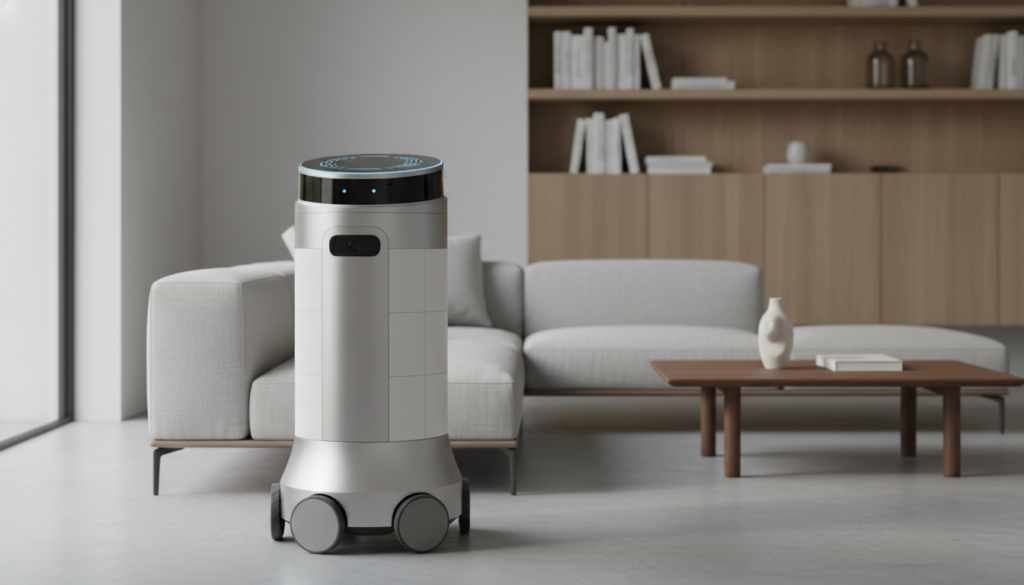
LG Electronics is preparing a major debut for its autonomous domestic robot at CES 2026. This system integrates advanced machine learning to execute complex household tasks. Consequently, it advances the zero-labor household concept.
Technical Architecture and Sensor Fusion
Understanding the core technical architecture is essential for consumers. The system utilizes multimodal sensor arrays for environmental awareness. Specifically, this includes LiDAR, RGB cameras, and ultrasonic sensors. Furthermore, these components enable precise spatial mapping and navigation. Consequently, the device avoids obstacles seamlessly during daily operation. Additionally, it relies on edge computing for real-time decision-making. Therefore, latency remains exceptionally low during complex manipulation tasks. Moreover, the system utilizes advanced robotic operating system protocols. This ensures stability across varied indoor environments and layouts. Subsequently, the hardware can adapt to dynamic household configurations continuously. Analysts at TechCrunch monitor these architectural advancements closely today. Additionally, the robot incorporates proprietary sensor fusion algorithms internally. This merges data streams into a cohesive environmental model. Consequently, blind spots are virtually eliminated during active movement. The LG automated home robot CES 2026 represents engineering excellence.
- Advanced LiDAR for precise spatial mapping processes.
- High-resolution RGB cameras for dynamic object recognition.
- Ultrasonic sensors for immediate physical obstacle detection.
- Dedicated neural processing units for local AI tasks.
- Articulated manipulator arms for delicate object handling.
Advanced Machine Vision and Spatial Mapping
Visual processing remains a critical component for autonomous navigation. Consequently, the hardware uses highly advanced optical lens configurations. Furthermore, the system processes high-resolution video streams continuously in real-time. This requires immense computational bandwidth from the onboard processor. Therefore, LG incorporates proprietary image signal processing algorithms efficiently. Moreover, the robot utilizes simultaneous localization and mapping techniques. Specifically, SLAM allows the device to understand dynamic environments accurately. Subsequently, the robot updates its internal floorplan whenever furniture moves. However, shadows and varied lighting conditions often challenge visual sensors. Thus, the integration of infrared sensors mitigates these environmental variables. Additionally, semantic segmentation helps the robot understand object context deeply. It differentiates between a fragile vase and a sturdy chair. Consequently, handling parameters adjust automatically based on object classification. The LG automated home robot CES 2026 processes data flawlessly.
- Stereo vision cameras for accurate environmental depth perception.
- Infrared projectors for reliable low-light indoor navigation.
- Semantic segmentation algorithms for detailed object classification.
- Real-time dynamic obstacle tracking and pathfinding avoidance.
- Automated optical calibration for sustained navigational accuracy.
Core Use-Cases in Real-World Scenarios
The LG automated home robot CES 2026 handles numerous tasks. Firstly, it executes autonomous floor cleaning and maintenance routines. Furthermore, the robot manages object retrieval and organization efficiently. Consequently, cluttered spaces become organized without human physical intervention. Additionally, the device assists with basic kitchen preparation steps. Therefore, it reduces the overall cognitive load on busy residents. Moreover, the robot serves as a mobile security patrol unit. It detects anomalies and alerts homeowners immediately upon discovery. Subsequently, users receive real-time notifications regarding their household status. The Internet of Things (IoT) ecosystem facilitates these seamless interactions. Furthermore, routine scheduling adapts to occupants’ behavioral patterns automatically. The system learns when spaces are typically empty for cleaning. Consequently, intrusive operations are minimized during peak household activity hours.
- Autonomous identification and sorting of scattered misplaced items.
- Proactive scheduling of intensive deep floor cleaning routines.
- Real-time environmental monitoring for potential safety hazards.
- Interactive physical assistance for elderly or disabled users.
- Continuous monitoring of indoor air quality and temperature.
Kinematics and Dexterous Manipulation Protocols
Physical interaction with objects requires highly advanced kinematic modeling. Therefore, the robot utilizes multi-axis articulated manipulator arms securely. Furthermore, these arms feature force-feedback sensors embedded within the grippers. Consequently, the system applies precise pressure based on object fragility. For instance, holding an egg requires vastly different force parameters. Moreover, the inverse kinematics engine calculates joint angles instantaneously. This allows smooth, human-like motion during complex retrieval tasks. Subsequently, the risk of dropping or damaging items decreases significantly. However, maintaining balance during heavy lifting presents a persistent challenge. Thus, dynamic weight redistribution algorithms adjust the robot’s center of gravity. Additionally, the end-effectors are modular and easily interchangeable by users. This design choice maximizes the hardware’s operational versatility dramatically.
| Kinematic Specification | Technical Parameter |
|---|---|
| Degrees of Freedom (Arms) | 7 DoF per individual manipulator arm |
| Maximum Payload Capacity | 5.0 kilograms per independent arm unit |
| Grip Force Resolution | 0.1 Newtons for delicate object handling |
| Actuator Response Time | Under 5 milliseconds for sudden adjustments |
| Reach Radius | 85 centimeters from the central chassis base |
Energy Management and Battery Infrastructure
Autonomous operation relies heavily on efficient energy management systems. Consequently, the LG automated home robot CES 2026 prioritizes battery longevity. The internal chassis houses a high-density solid-state battery pack. Furthermore, this chemistry offers superior safety profiles compared to lithium-ion. Therefore, fire risks are virtually eliminated within the domestic environment. Moreover, the robot monitors its own energy consumption continuously. It routes power away from inactive sensors to extend runtime. Subsequently, when the battery depletes, it navigates homeward autonomously. The inductive charging base eliminates the need for exposed electrical contacts. Thus, the charging process remains safe around children and pets. Additionally, predictive charging algorithms learn household utility rate schedules. The robot prioritizes charging during off-peak economic utility hours.
- High-density solid-state battery for enhanced operational safety.
- Contactless inductive charging base for seamless power replenishment.
- Dynamic power routing to minimize idle energy waste.
- Predictive charging algorithms aligned with utility grid pricing.
- Thermal management systems to prevent internal hardware overheating.
Ecosystem Integration within LG ThinQ
Standalone devices rarely succeed in modern integrated smart environments. Therefore, the device connects directly with the LG ThinQ ecosystem. Consequently, the robot communicates with existing smart appliances seamlessly. For example, it can initiate the washing machine cycle autonomously. Furthermore, it interacts with smart refrigerators to monitor internal inventory. Moreover, this interconnected framework utilizes a centralized secure data hub. The robot acts as the physical agent for this network. Subsequently, it executes commands generated by the overarching household system. Experts at The Verge frequently review such ecosystem synergies. Additionally, voice commands issued to smart speakers route to the robot. This creates a frictionless user experience across multiple branded devices. The LG automated home robot CES 2026 connects everything perfectly.
- Wi-Fi 7 integration for high-bandwidth local data transmission.
- Bluetooth Low Energy for accurate indoor proximity detection.
- Matter protocol support for broad cross-brand appliance compatibility.
- Encrypted cloud pathways for secure background firmware updates.
- Seamless integration with existing LG smart home appliances.
Edge Computing and Neural Processing Power
Cloud processing introduces latency that physical robots cannot tolerate safely. Consequently, the LG automated home robot CES 2026 prioritizes edge computing. The onboard neural processing unit handles billions of operations locally. Therefore, critical object recognition occurs in mere fractions of milliseconds. Furthermore, this localized processing ensures functionality during internet service outages. Moreover, the AI models undergo rigorous quantization and pruning processes. This compresses the algorithms to fit within hardware memory constraints. Subsequently, the robot operates efficiently without draining the battery rapidly. Additionally, hardware accelerators specifically manage the complex spatial mapping workloads. This prevents the primary CPU from becoming bottlenecked during movement. To understand broader hardware processing trends, visit our Consumer Tech hub.
- Dedicated Neural Processing Unit for local AI execution.
- Hardware-accelerated SLAM coprocessor for real-time spatial mapping.
- Quantized machine learning models optimized for edge deployment.
- Offline operational capability during temporary internet network disruptions.
- Low-power standby modes to preserve computational energy reserves.
Interoperability and Open Standard Support
Proprietary silos restrict the broader adoption of home automation technologies. Therefore, LG embraces open standards with this upcoming robotic release. Furthermore, adherence to the Matter protocol ensures wide compatibility. Consequently, the robot interacts flawlessly with devices from competing manufacturers. This reduces friction for consumers with diverse smart home setups. Moreover, open application programming interfaces encourage third-party developer contributions. Independent developers can create custom behavioral skills for the robot. Subsequently, the device’s utility expands far beyond factory default settings. However, strict certification processes govern these third-party integrations for safety. Thus, malicious code cannot compromise the robot’s core kinematic functions. Additionally, standardized communication protocols reduce overall network congestion significantly.
| Protocol Standard | Primary Functionality |
|---|---|
| Matter 1.3 | Cross-brand smart home device communication |
| Thread | Low-power mesh networking for peripheral sensors |
| WebRTC | Secure peer-to-peer video streaming for remote monitoring |
| MQTT | Lightweight telemetry data transmission to the local hub |
| ROS2 DDS | Real-time internal robotic subsystem data exchange |
Data Privacy and Security Standards
Advanced home robotics collect immense amounts of intimate personal data. Consequently, privacy concerns remain a significant barrier to mainstream adoption. However, the system mitigates these risks through rigorous localized processing. Therefore, sensitive video and audio feeds remain strictly on the device. Furthermore, the robot anonymizes necessary telemetry data before any external transmission. Moreover, hardware-level encryption secures all internal local storage modules definitively. Unauthorized physical access attempts trigger immediate system lockdowns automatically. Subsequently, users maintain total sovereign control over their household information. Global agencies like Reuters frequently report on tech privacy regulations. Additionally, users can define physical privacy zones via the companion application. The robot disables recording equipment automatically upon entering these designated areas.
- End-to-end encryption for all external network communications.
- Biometric user authentication for administrative level access control.
- Physical shutter hardware switches for onboard cameras and microphones.
- Regular automated security audits for critical vulnerability patching.
- Customizable localized privacy zones utilizing virtual geofencing boundaries.
Consumer Adoption Bottlenecks and Trade-offs
Despite advanced engineering, several consumer adoption bottlenecks persist globally. Firstly, the initial retail cost prohibits widespread mainstream market penetration. Consequently, early models serve as luxury status symbols for affluent demographics. Furthermore, maintaining complex robotic systems requires specialized technical support infrastructure. Therefore, rural consumers might experience prolonged downtime during hardware failures. Moreover, psychological resistance to autonomous machines roaming homes remains prevalent. Many users feel uncomfortable relinquishing control of domestic chores entirely. Subsequently, establishing user trust represents a massive hurdle for marketing departments. However, transparent operational design helps alleviate some of these underlying fears. Thus, the robot clearly broadcasts its intended actions via visual indicators. Additionally, pets and young children present unpredictable variables during operation.
- High initial retail pricing restricting broader consumer market access.
- Specialized maintenance requirements complicating long-term hardware ownership.
- Psychological barriers regarding autonomous machines in private domestic spaces.
- Unpredictable interactions with household pets and small active children.
- Potential software subscription costs for advanced cloud-based AI features.
Market Position and Economic Implications
The financial implications of this ambitious product release are substantial. The LG automated home robot CES 2026 targets premium segments initially. Consequently, early adoption will drive significant short-term revenue spikes. However, economies of scale will eventually drive hardware production costs down. Therefore, broader market penetration becomes increasingly feasible over subsequent fiscal years. Furthermore, this launch intensifies competition among major global tech conglomerates. Rivals must accelerate their own robotics research and development programs immediately. Subsequently, the entire sector will experience incredibly rapid product innovation cycles. Financial platforms like Bloomberg track these competitive market dynamics comprehensively. Additionally, the supply chain for specialized robotic components will expand massively. This creates lucrative opportunities for secondary hardware component manufacturers globally.
- Stimulation of secondary hardware component manufacturing supply chains.
- Increased venture capital investment in rival robotics startup companies.
- Gradual reduction of component costs through manufacturing economies of scale.
- Creation of specialized technical jobs for robotic maintenance and support.
- Potential disruption of traditional manual domestic cleaning service industries.
Future Expansions and Hardware Evolution
The initial hardware release marks only the developmental beginning phase. The platform establishes a robust foundational architecture for future applications. Consequently, future iterations will expand upon these initial capabilities significantly. We expect specialized modular attachments for specific outdoor maintenance tasks eventually. Furthermore, enhanced natural language processing will refine complex user interactions further. Moreover, continuous machine learning will improve operational efficiency over time. The robot will learn granular household routines and optimize its schedule. As a result, the ultimate zero-labor vision edges much closer to reality. Additionally, swarm intelligence could allow multiple smaller robots to collaborate seamlessly. This distributes complex tasks across a synchronized robotic workforce efficiently. Ultimately, the Robotics and Automation space will never be exactly the same.
- Development of specialized modular attachments for outdoor yard maintenance.
- Integration of highly advanced natural language processing conversational models.
- Implementation of swarm intelligence for multi-robot household collaboration.
- Enhanced battery chemistries for multi-day continuous autonomous operation.
- Broader integration with municipal smart city digital infrastructure grids.















1 thought on “LG Zero Labor Home Robot 2026: The End of Household Chores?”
Pingback: Apple Explores AI Pin and Robotic Home Hub Prototypes | Techaloop | Stay in the Loop | Lead the Future.